Design Of an Inductive Wireless Charging Station for Electric Vehicles with A Low-Power Experimental Validation of The Power-Transfer Chain
Keywords:
Abstract
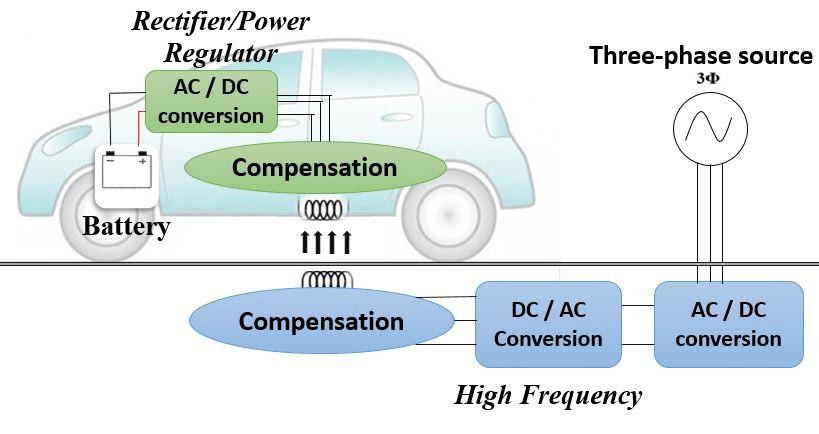
Conductive charging of electric vehicles (EVs) requires the user to handle a connector, exposes contacts to weather and mechanical wear, and presents a shock hazard in public installations. Wireless power transfer (WPT) removes the physical connector by coupling energy across an air gap between a ground-mounted transmitter coil and a vehicle-mounted receiver coil. This paper reports a two-part study. The first part is a design analysis of an inductive EV charging station: the conversion chain from AC mains through rectification, high-frequency inversion, resonant coupling, secondary rectification and battery management is specified; the governing resonance condition is stated; the applicable standards framework is reviewed, comprising SAE J2954, IEC 61980 and the Qi specification; and the safety provisions required for outdoor operation — electromagnetic shielding, foreign-object detection, thermal management and enclosure sealing — are defined. The second part is an experimental validation carried out at low power. A 12 W transformer, a four-diode full-wave rectifier and a 5 V inductive transmitter module were used to energise a receiver at a separation of approximately 2–5 cm. The receiver delivered 4.6–5 V with stable current across repeated trials, giving an estimated end-to-end efficiency of 70–75 % once transformer, rectification and coupling losses are accounted for; no component exceeded its safe operating temperature during testing. It is stated explicitly that this prototype operates roughly three orders of magnitude below EV charging power and therefore validates the principle of the conversion chain rather than the EV-scale design. A tariff and cost analysis for the Tamil Nadu context is included, and the measurements required to progress from the present demonstrator towards a deployable station are set out.