An IoT-Instrumented Framework for Enhancing Solar Panel Efficiency
Keywords:
Abstract
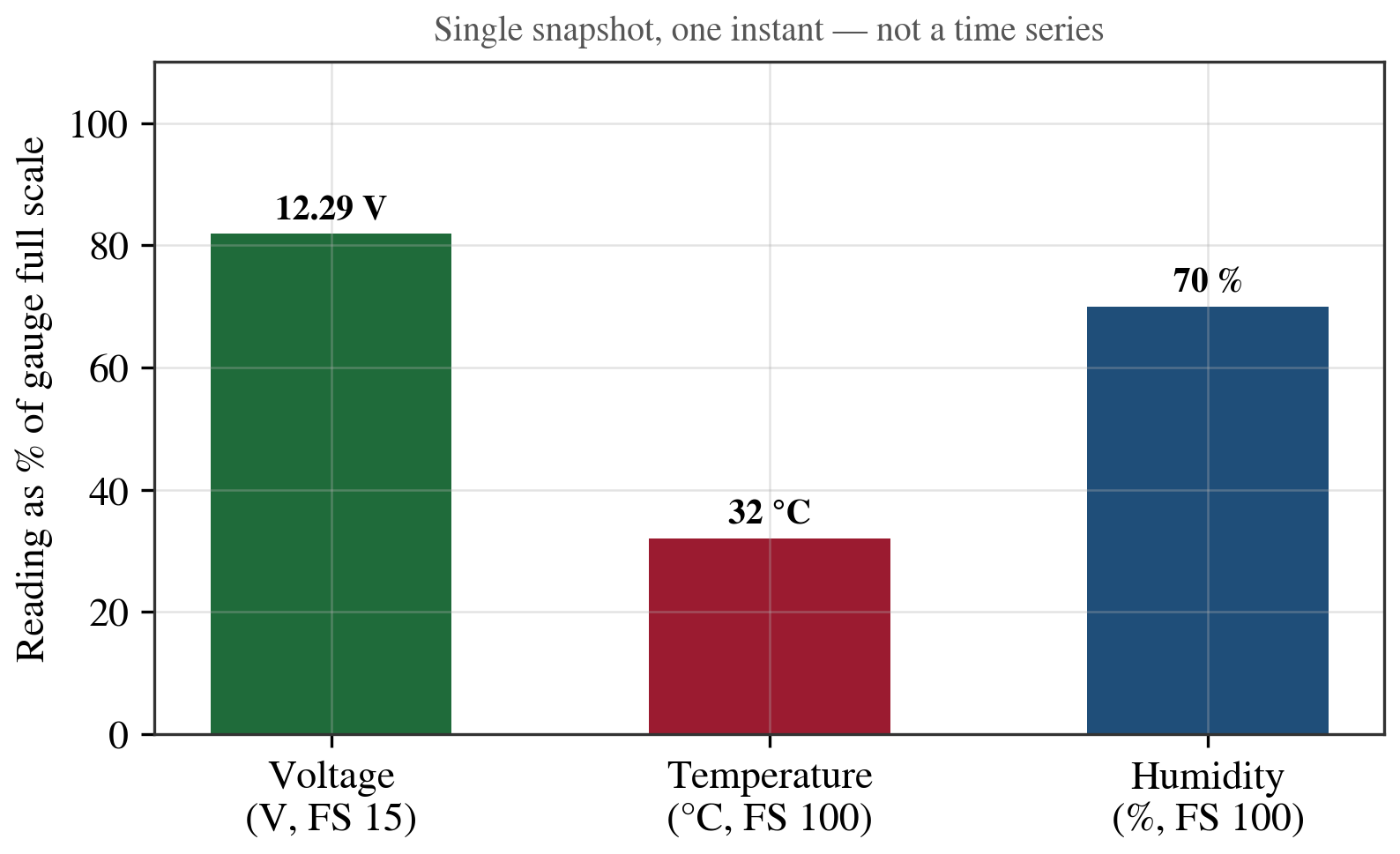
This paper reports the design, construction and instrumented assessment of a low-cost photovoltaic monitoring and actuation node intended to support solar-panel efficiency enhancement in residential installations. The prototype couples a PV module and a lead-acid battery to an ESP8266-based NodeMCU controller that samples panel voltage together with ambient temperature and relative humidity, drives a relay-switched DC actuator, and publishes every channel to a Blynk cloud dashboard over Wi-Fi. The telemetry actually recorded during the demonstration is reported exactly as captured: a single dashboard snapshot giving 12.29 V, 32 degrees Celsius ambient temperature and 70 % relative humidity, with the actuator in the OFF state, at one instant. Two limitations are stated openly rather than concealed. First, the dataset is a single instant on three channels, so no time series, no distribution and no uncertainty estimate can be derived from it. Second, and more consequentially, panel current was never sensed, so panel power, energy yield and any efficiency ratio, which are the very quantities the project title promises, cannot be evaluated from the recorded data, and no efficiency figure is fabricated here. The paper formalises the photovoltaic, thermal-derating and power-balance relations that the architecture presumes; adds a table of independently verifiable reference values, including the standard test conditions against which every efficiency claim is defined; and develops, under assumptions that are stated as assumptions, the thermal derating implied by the recorded 32 degrees Celsius ambient, which lies between about 10 % and 19 % of the standard-test-condition rating at full irradiance. It separates explicitly what is measured, what is computed, what is built but unmeasured, and what remains aspirational in the source design, and specifies the exact instrumentation required to convert the prototype into a quantitative efficiency study. The contribution is a disciplined, traceable path from a working but lightly instrumented teaching prototype to a deployable PV monitoring architecture.