An IoT Face-Recognition Door-Lock System
Keywords:
Abstract
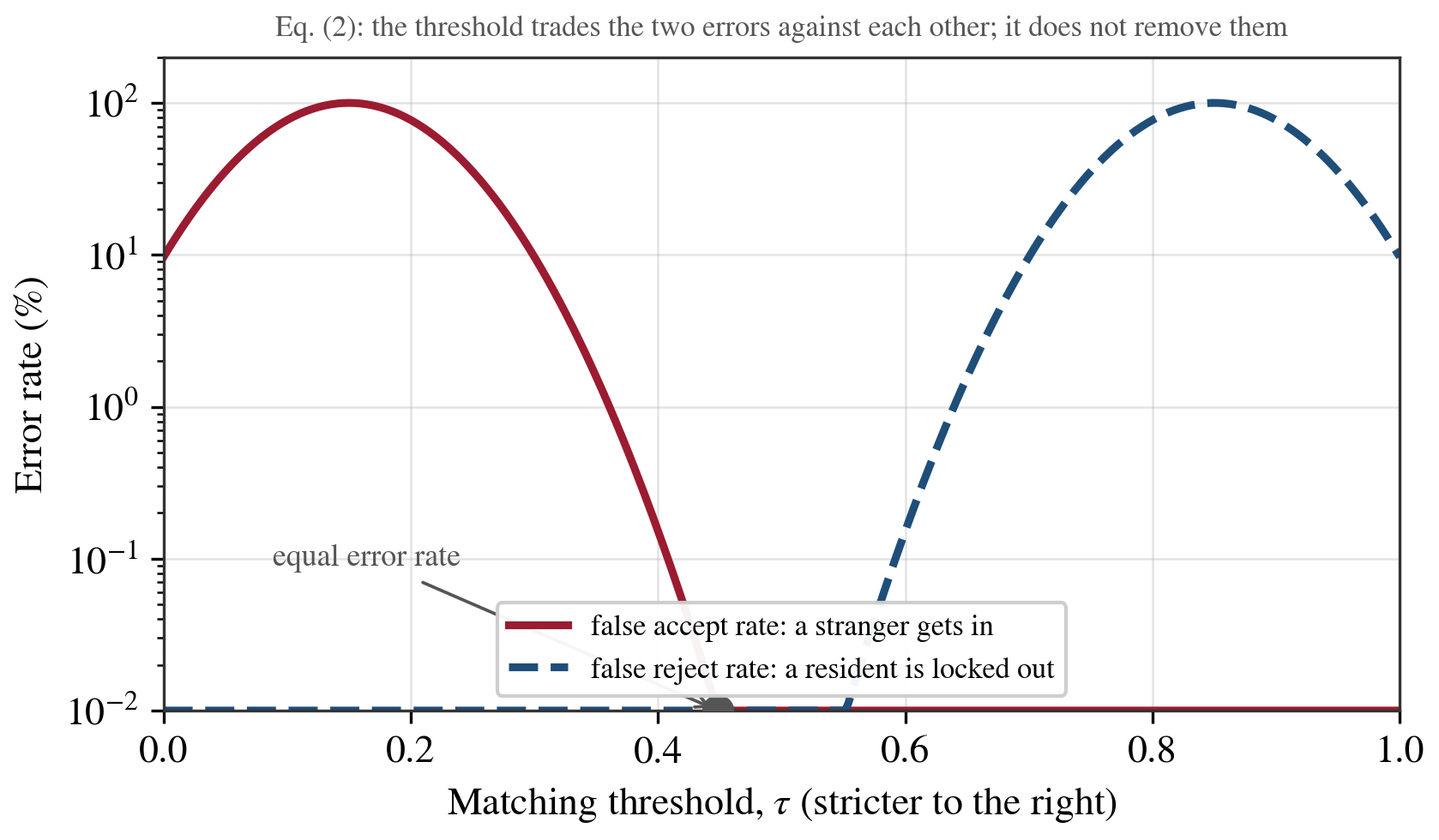
This paper reports the design of a face-recognition door-lock system for home automation, in which a webcam at the entrance feeds a computer running a YOLOv4 detector, a set of enrolled face images is held as a database, and an Arduino Uno drives the relay that releases the lock when a presented face matches the database. The paper formalises the detection, matching and decision relations the system rests on, and then examines what a lock of this kind has to be measured by. Three findings follow, and each is quantitative. First, YOLOv4 is an object detector: it answers whether a face is present and where, and does not answer whose face it is. Recognition additionally requires alignment, an embedding and a matching step against the enrolled set, and the algorithm performing that step is not named in the project record. Second, a door lock is a biometric access-control system and its security is the false accept rate at a stated threshold, not an accuracy percentage. Because the lock performs open-set identification against every enrolled person rather than verification against one, the system false accept rate grows with the number enrolled: a per-comparison rate of 0.1 per cent gives a system rate of about 1 per cent with ten residents enrolled and about 5 per cent with fifty. Converted into operational terms, at ten impostor presentations per day a system rate of 1 per cent admits a stranger about once every ten days. Third, a webcam-based system without liveness detection is defeated by a printed photograph, and no anti-spoofing stage appears in the described design. The paper also notes that the recognition decision is taken on the computer and conveyed to the Arduino as a serial command, so the serial link is the trust boundary, and that the behaviour on computer failure is unspecified. A four-trial measurement plan is given. This paper was prepared from the project abstract alone, so status entries are marked for confirmation rather than asserted.