Design and Implementation of Wireless Sensor Network-Based Environmental Monitoring Systems
DOI:
https://doi.org/10.65521/ijaece.v7i1.4328Keywords:
Abstract
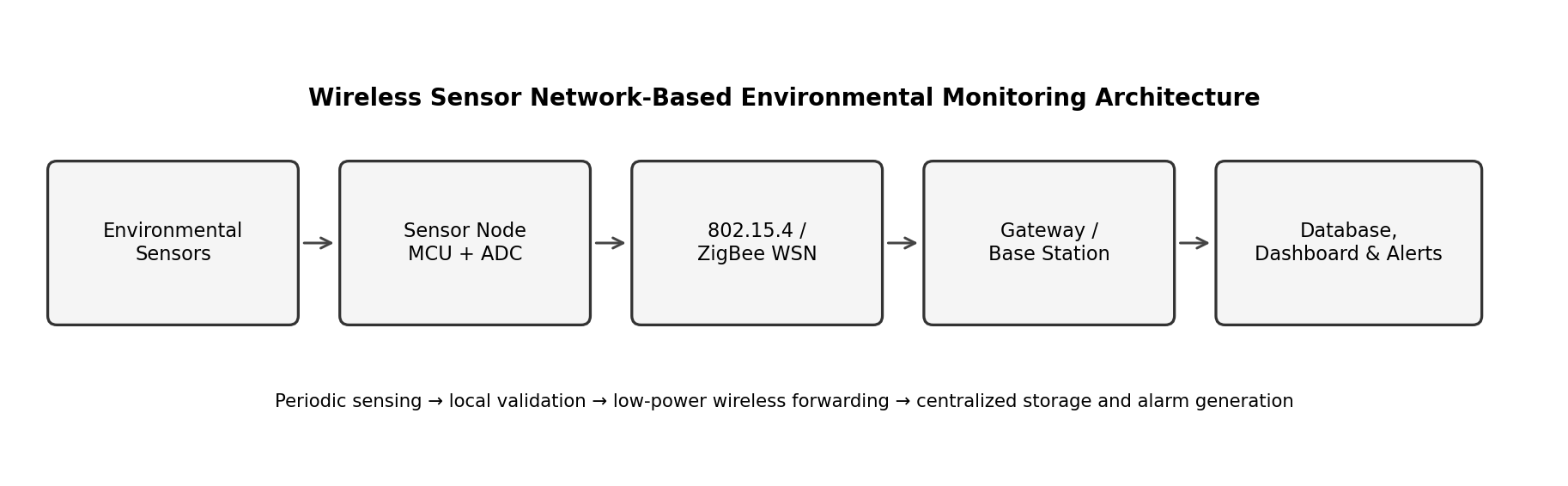
Wireless sensor networks (WSNs) provide a practical platform for continuous environmental observation because distributed sensor nodes can measure local physical variables and forward data without extensive cabling. This paper presents a methodology for the design and implementation of a WSN-based environmental monitoring system intended for temperature, relative humidity, light intensity, soil-moisture, and air-quality observation. The proposed architecture combines low-power sensing nodes, an IEEE 802.15.4/ZigBee-class wireless link, multi-hop forwarding, a gateway, and a centralized database/dashboard. The methodology proceeds from requirement definition and sensor selection to node hardware integration, communication design, power management, data validation, gateway processing, and performance verification. Energy use is reduced through periodic sampling, radio duty cycling, local threshold filtering, and short packet transmission. A design-level evaluation is reported rather than fabricated field measurements: under a five-minute sampling interval and representative component-current assumptions, the average node current is approximately 0.26 mA and the expected usable lifetime of a 2400 mAh battery is about 266 days after applying a 70% utilization factor. Link-budget analysis also indicates that a 30 m outdoor hop can retain roughly 15 dB margin under a conservative path-loss model. These estimates show that the design is suitable for low-maintenance monitoring where moderate data rates and long operating life are more important than high-bandwidth communication. The methodology can be adapted to farms, greenhouses, forests, water bodies, campuses, and industrial environmental observation.