Wireless Sensor Network-Based Environmental Monitoring for Remote Applications
DOI:
https://doi.org/10.65521/ijaece.v8i1.4461Keywords:
Abstract
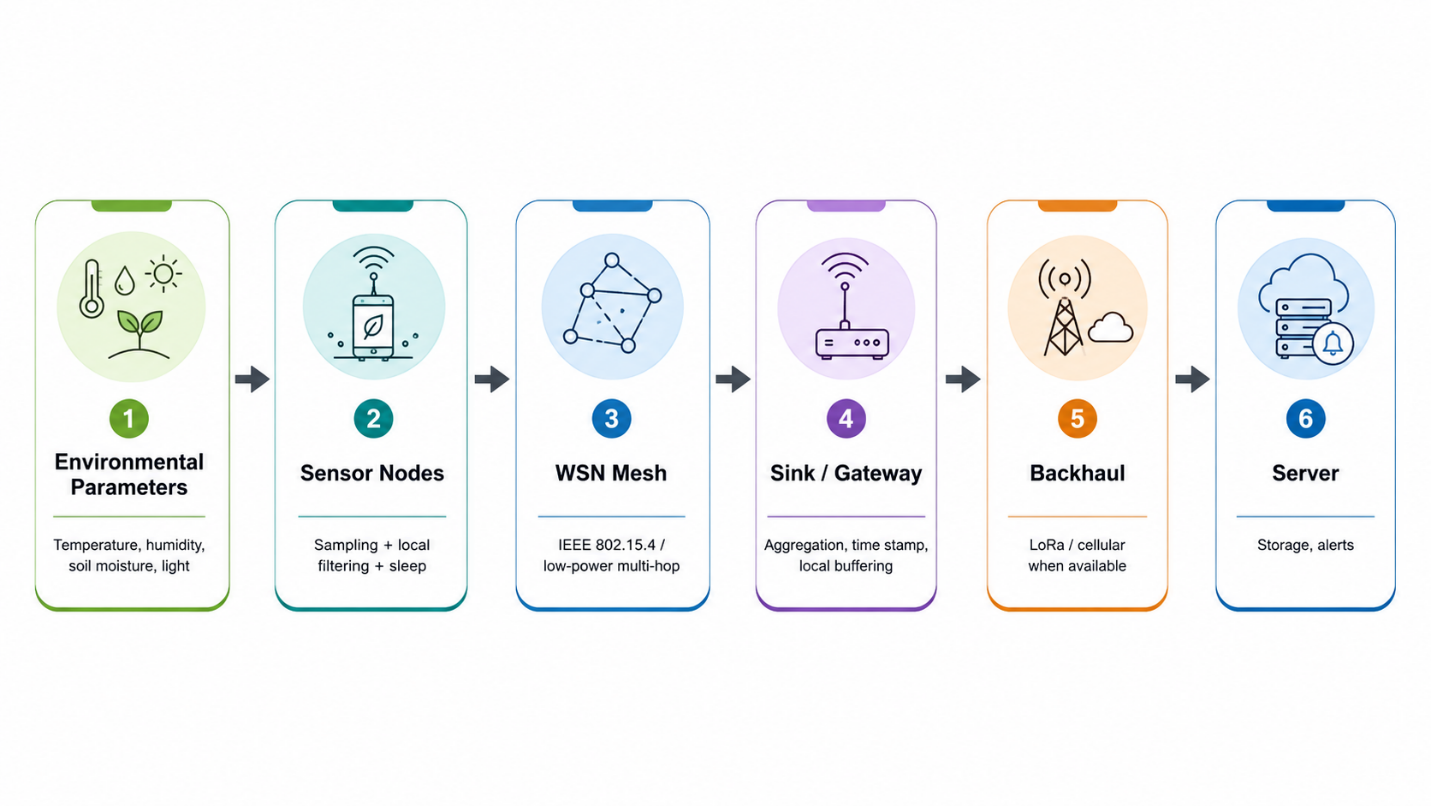
Wireless sensor networks (WSNs) provide a practical foundation for monitoring environmental variables in remote locations where wired infrastructure, continuous power, and frequent human access are unavailable. This methodology paper develops and evaluates a low-power WSN architecture for remote environmental monitoring using distributed sensor nodes, short-range multi-hop communication, a gateway with local buffering, and a long-range backhaul to a remote server. The design targets temperature, relative humidity, soil moisture, and light intensity while emphasizing low energy use, reliable data delivery, and tolerance of intermittent gateway connectivity. A simulation/analytical evaluation compares an always-on baseline with the proposed duty-cycled sensing and communication strategy. Under the defined assumptions, the proposed architecture reduces estimated daily node energy from 68.4 J to 17.9 J, increases packet delivery ratio from 95.1% to 97.2%, and extends estimated battery-supported node lifetime from about 7.4 to 27.8 months, with a modest increase in median reporting latency. The results indicate that adaptive sampling, local buffering, and low-power mesh communication are suitable design choices for long-term remote monitoring. The study also identifies limitations related to radio propagation, sensor calibration, battery aging, and the gap between simulation and field deployment.