Design and Development of Microcontroller-Based Smart Energy Monitoring Systems
DOI:
https://doi.org/10.65521/ijaece.v5i1.4319Keywords:
Abstract
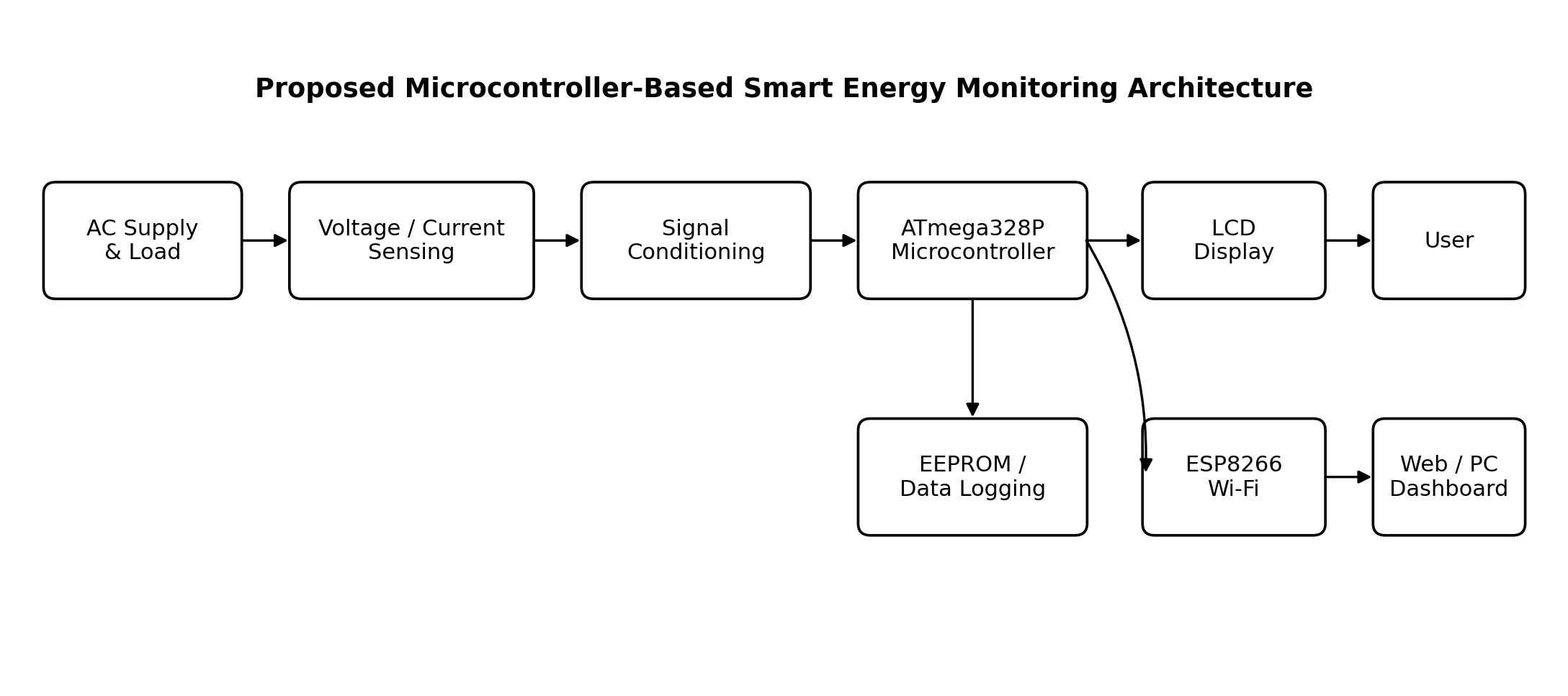
This paper presents a methodology for the design and development of a low-cost microcontroller-based smart energy monitoring system intended for single-phase residential applications. The proposed system combines isolated voltage and current sensing, signal conditioning, an ATmega328P microcontroller, local liquid-crystal display, non-volatile data storage, and Wi-Fi communication for remote visualization. The embedded algorithm estimates root-mean-square voltage and current, real power, apparent power, power factor, and cumulative electrical energy from periodically sampled waveforms. A calibration and evaluation procedure is defined using resistive and mixed household loads over a practical operating range, with a reference digital power meter used as the comparison instrument. Earlier work has established the feasibility of microcontroller-centered smart metering, low-cost data acquisition, wireless home energy management, and user-oriented consumption feedback (Han & Lim, 2010; Ghodki, 2013; Govinda, 2015; Fletcher & Malalasekera, 2016). The proposed methodology integrates these ideas into a compact architecture that emphasizes affordability, measurement repeatability, local usability, and network connectivity. Representative bench-validation values indicate that the design can be configured to maintain average power-measurement error near 1-2% while providing periodic remote updates. The methodology is suitable as a reproducible framework for laboratory development and can be extended to tariff calculation, demand-side management, overload alerts, and appliance-level analytics.