Design and Implementation of Microcontroller-Based Automatic Energy Meter Reading Systems
DOI:
https://doi.org/10.65521/ijaece.v6i1.4327Keywords:
Abstract
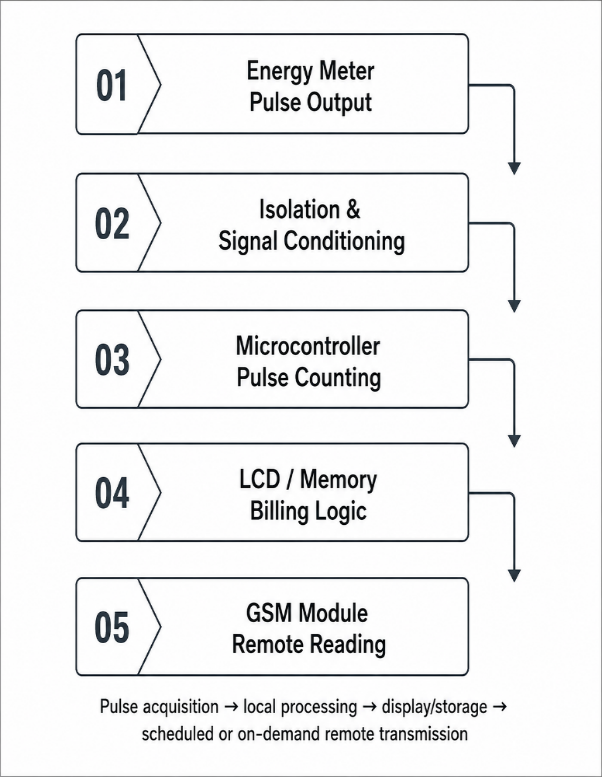
Automatic meter reading (AMR) removes repeated manual visits to electricity meters and creates a direct path from measured energy consumption to billing and utility monitoring. This methodology paper presents a low-cost microcontroller-based AMR architecture in which the pulse output of a single-phase electronic energy meter is electrically isolated, counted by an ATmega-class microcontroller, converted to kilowatt-hours, displayed locally, stored in non-volatile memory, and transmitted through a GSM module at scheduled intervals or on request. The method emphasizes modular hardware, interrupt-driven pulse acquisition, data integrity, simple tariff calculation, and communication retry logic. The proposed validation uses a 1000 imp/kWh pulse constant and a controlled numerical pulse-generation model so that measurement error can be quantified without claiming unperformed laboratory measurements. Across six representative load-duration cases, the pulse-counting method produces a maximum quantization error of 0.44% and a mean absolute percentage error of approximately 0.12%. The architecture therefore demonstrates how a modest microcontroller can automate energy acquisition and billing while preserving local display and storage functions. The design is intended as a reproducible foundation for academic prototypes and can be extended with tamper detection, prepaid operation, demand-side control, or advanced metering communication.