Design and Performance Evaluation of Smart Energy Metering Systems Using Microcontroller-Based Technology
DOI:
https://doi.org/10.65521/ijaece.v7i1.4332Keywords:
Abstract
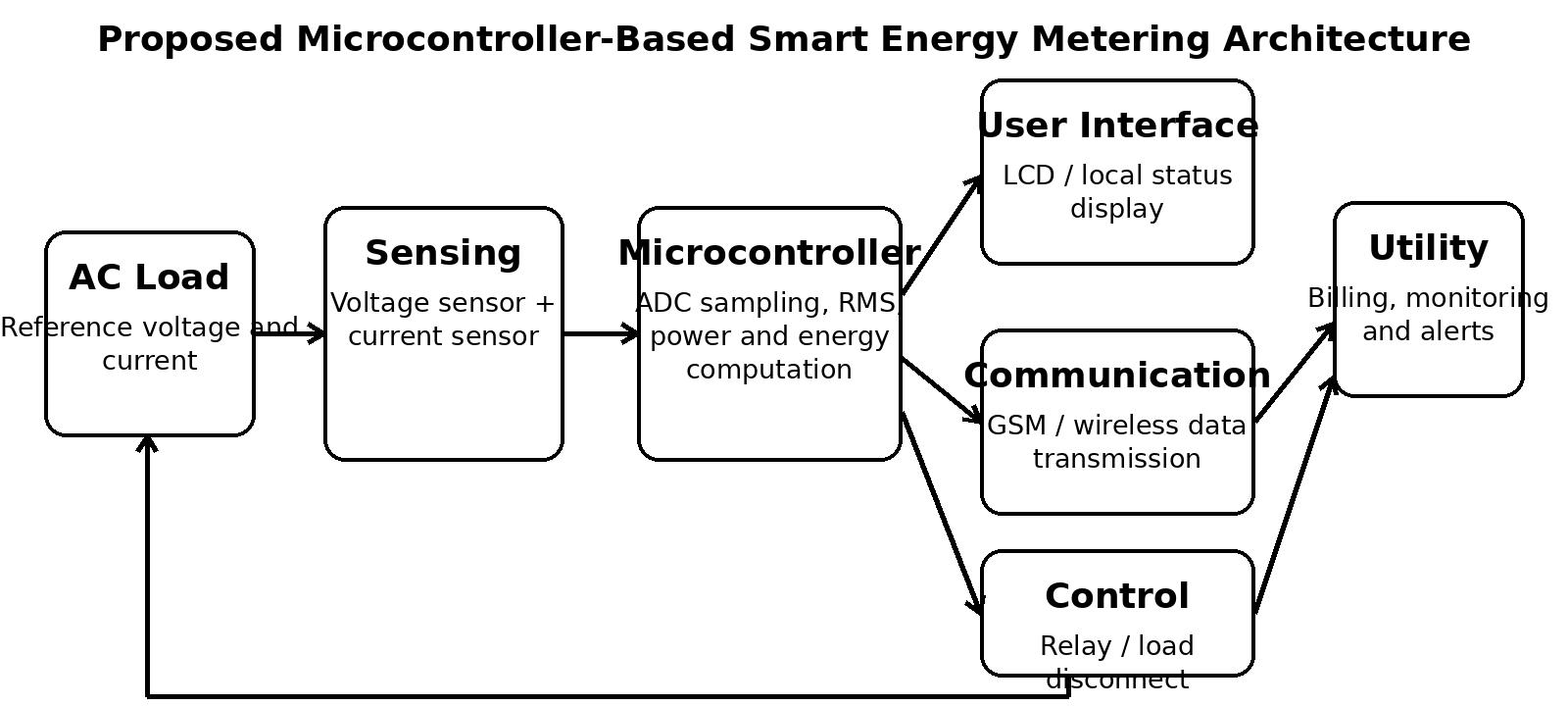
Smart energy metering combines electrical measurement, embedded processing, communication, and load-control functions to improve the accuracy and availability of consumption information. This methodology paper presents the design and performance-evaluation framework for a low-cost microcontroller-based smart energy meter suitable for residential and small commercial loads. The proposed architecture uses isolated voltage and current sensing, analog-to-digital conversion, microcontroller-based calculation of RMS voltage, RMS current, active power, and accumulated energy, a local display, a communication interface, and relay-based load control. Performance is evaluated using calibrated reference inputs at multiple load levels and power factors. The principal indicators are energy-measurement error, response time, communication success rate, control latency, and functional reliability. A simulation-based benchmark demonstrates how the protocol can quantify expected accuracy and communication performance before hardware field deployment. The approach emphasizes modularity, low computational overhead, and compatibility with automated metering infrastructure. The methodology provides a reproducible basis for comparing microcontroller-based smart-meter prototypes while identifying calibration, communication reliability, and security as the main issues requiring validation in a final laboratory or field implementation.