Recent Advances in Deep Recursive Self-Attention Modules: MANET-Based Integrated Sensor System for Disaster Detection and Communication in Hazardous Environments: A Systematic Review
Keywords:
Abstract
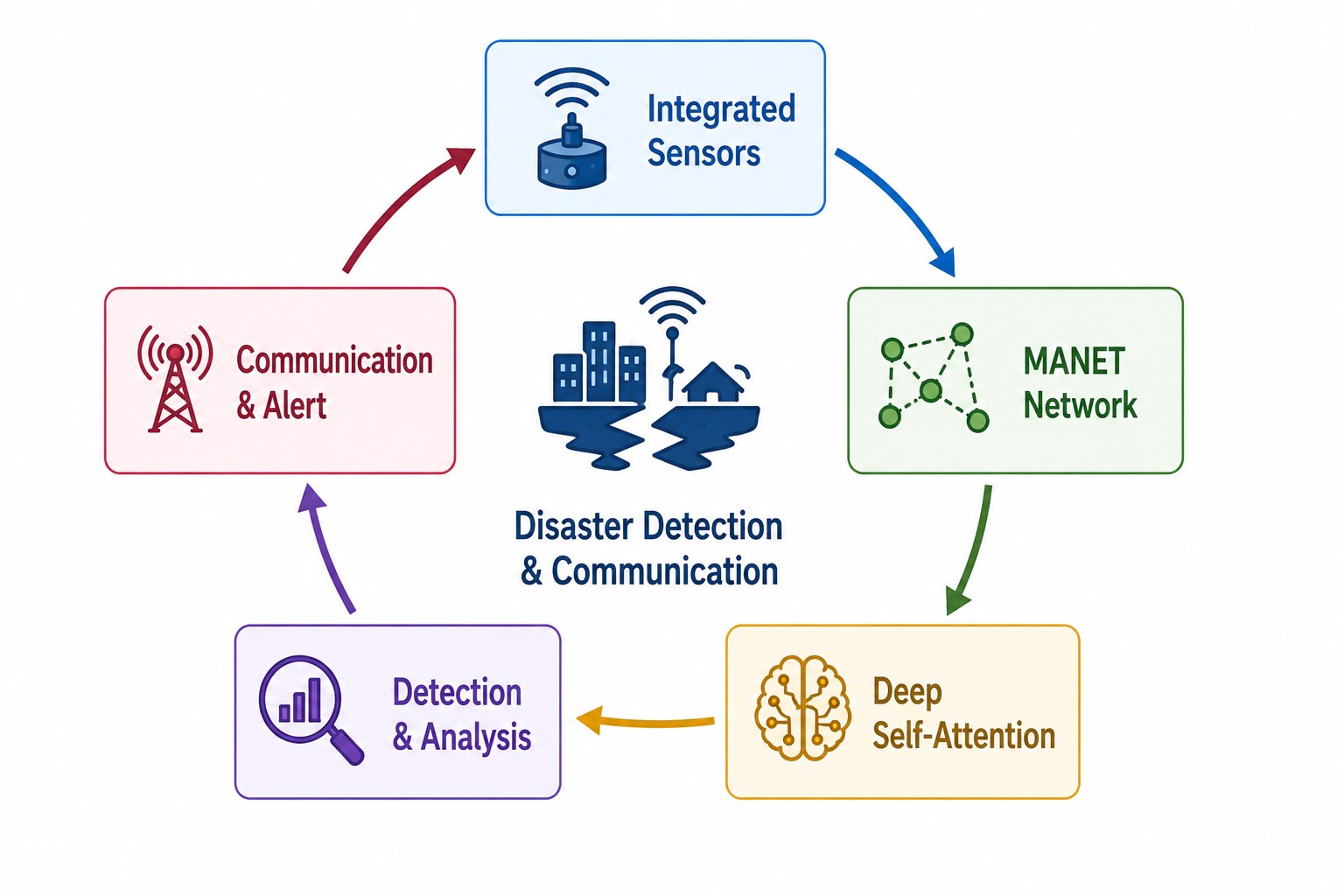
Disaster detection and communication in hazardous environments require robust, scalable, and intelligent systems capable of real-time monitoring and decision-making. Mobile Ad Hoc Networks (MANETs) combined with integrated sensor systems have emerged as a promising solution for enabling decentralized communication in disaster-prone regions. Recent advancements in deep learning, particularly deep recursive self-attention modules, have significantly enhanced the capability of such systems to process large-scale sensor data efficiently. Self-attention mechanisms allow models to focus on critical features while ignoring irrelevant information, improving detection accuracy and system reliability. Studies indicate that attention-based deep learning models enhance performance in image classification, object detection, and environmental monitoring tasks by effectively capturing spatial and temporal dependencies. Furthermore, deep learning has transformed intelligent sensor systems by enabling automatic feature extraction and real-time data analysis across heterogeneous data sources. In disaster scenarios, such systems can detect anomalies, predict hazards, and facilitate communication through MANET-based architectures without relying on centralized infrastructure. Additionally, advanced attention-based models and hybrid architectures have demonstrated improved performance in disaster image classification and risk assessment tasks. This review presents a comprehensive analysis of deep recursive self-attention modules integrated with MANET-based sensor systems, highlighting recent developments, architectural advancements, challenges, and future research directions for disaster detection and communication in hazardous environments.