
Deep-Fake Image Detection Using Machine Learning Techniques: A Comprehensive Review
DOI:
https://doi.org/10.65521/ijaece.v15i1S.1350Keywords:
Abstract
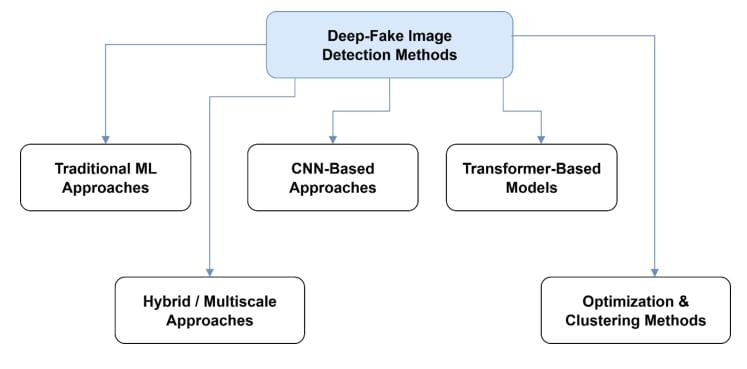
The rapid development of deep generative models like Generative Adversarial Networks (GANs) and Diffusion Models has made visual synthetic images such as deep-fake very realistic, representing a possible threat to digital trust, privacy and national security. This survey offers an overview of machine learning (ML) based methods for deep-fake image detection, including classical ML classifiers, convolution neural network (CNN) architectures attention mechanisms, multimodal systems, and hybrid feature fusion models. The paper analyses commonly-used datasets, performance evaluation criteria and the most recent state-of-arts on benchmarks such as Celeb-DF, FaceForensics++ and DeepFake Detection Challenge (DFDC). A comparison of the two approaches would discuss the advantages and drawbacks as well as generalisability issues with ML to unknown manipulations. Finally, the review points to important open challenges such as cross-dataset generalization, explainability analysis, adversarial susceptibility and multimodel deep-fake attacks-and draws future research directions to make trustful detection deep-fake systems.
Downloads
Published
How to Cite
Issue
Section
License

This work is licensed under a Creative Commons Attribution-NoDerivatives 4.0 International License.
