
A Comparative Study of Machine Learning Models for Sentiment Analysis of IMDb Movie Reviews
DOI:
https://doi.org/10.65521/ijacte.v15i1.3815Keywords:
Abstract
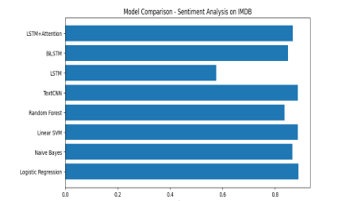
The rapid growth of online platforms has resulted in an enormous volume of user-generated textual data, making automated sentiment analysis an essential task in Natural Language Processing (NLP). Movie review platforms such as IMDb generate large-scale opinionated text that provides valuable insights into audience perception, but manual analysis of such data is impractical. This project presents a comprehensive comparative study of classical machine learning and deep learning models for sentiment analysis of IMDb movie reviews.The proposed system implements a unified experimental framework in which classical machine learning models—Logistic Regression, Naïve Bayes, Support Vector Machine, and Random Forest—are compared against deep learning models including TextCNN, LSTM, BiLSTM, and LSTM with Attention. Classical models utilize TF-IDF based feature representation, while deep learning models rely on embedding-based sequence learning. All models are evaluated under identical preprocessing and testing conditions to ensure fairness and reproducibility. Performance evaluation is carried out using multiple metrics such as classification accuracy, training time, inference time, and model complexity. Experimental results reveal that classical machine learning models, particularly Logistic Regression and Linear SVM, achieve accuracy comparable to or higher than deep learning models while requiring significantly fewer computational resources. Among deep learning approaches, TextCNN demonstrates the best balance between accuracy and efficiency. The study highlights that increased model complexity does not necessarily guarantee superior performance.The findings of this research emphasize the importance of considering computational efficiency and deployment constraints alongside accuracy. This work provides practical guidelines for selecting suitable sentiment analysis models based on application requirements and resource availability, making it valuable for both academic research and real-world applications
Downloads
Published
How to Cite
Issue
Section
License

This work is licensed under a Creative Commons Attribution-NoDerivatives 4.0 International License.
