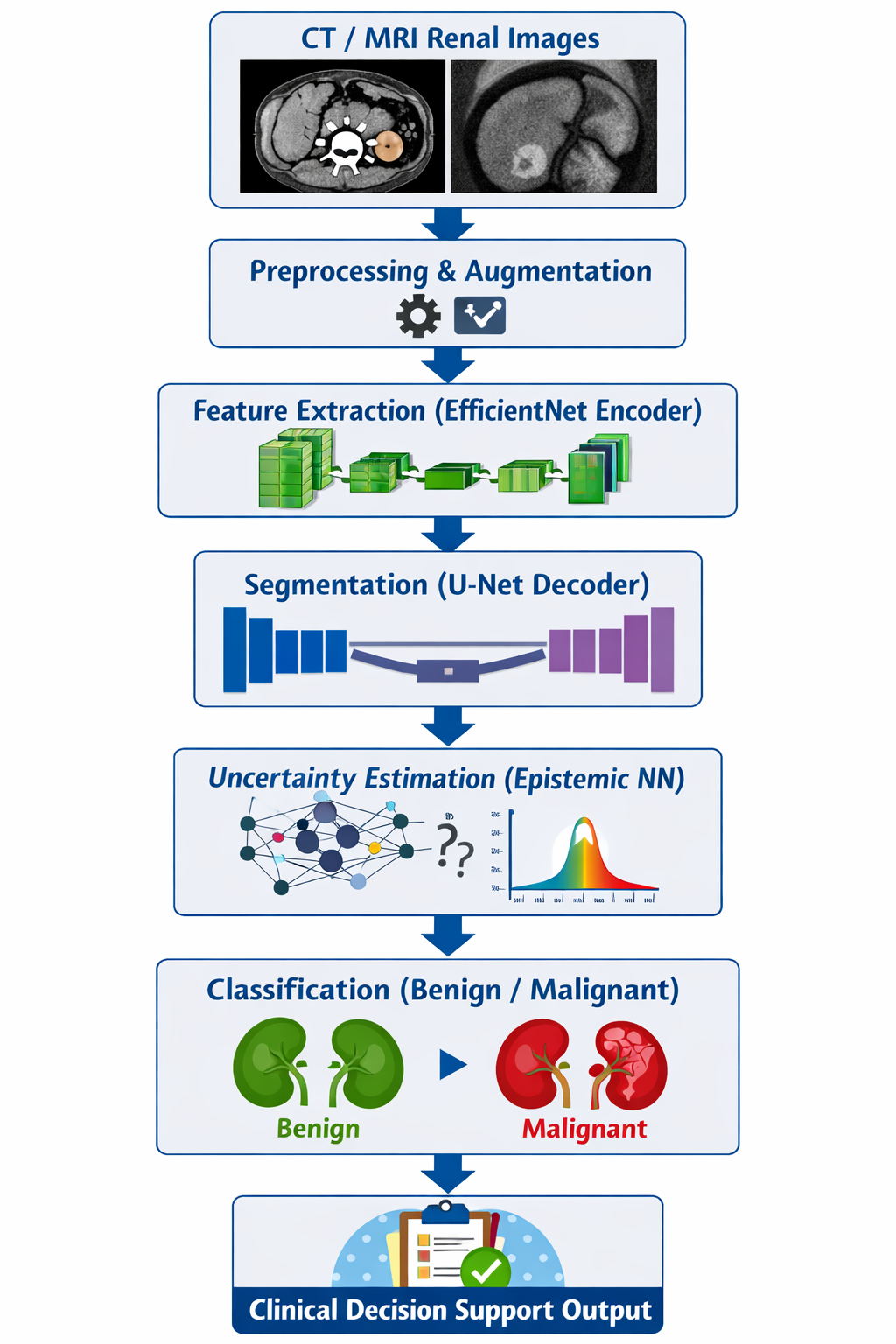
Artificial Intelligence Techniques for Segmentation and Classification of Renal Tumors Using EfficientNet-Based U-Net and Epistemic Neural Networks: Trends and Challenges
DOI:
https://doi.org/10.65521/ijacte.v13i1.3784Keywords:
Abstract
Renal tumor detection and classification play a crucial role in early diagnosis and treatment planning for kidney cancer. With the advancement of Artificial Intelligence (AI), deep learning-based approaches have significantly improved the accuracy and efficiency of medical image analysis. This paper presents a comprehensive review of AI techniques for renal tumor segmentation and classification, focusing on EfficientNet-based U-Net architectures and epistemic neural networks. EfficientNet enhances feature extraction through compound scaling, while U-Net provides precise localization via encoder–decoder structures. The integration of epistemic uncertainty modeling further improves reliability by quantifying prediction confidence, which is essential for clinical decision-making. Recent studies demonstrate that hybrid U-Net architectures, attention mechanisms, and transformer-based enhancements achieve high Dice coefficients and Intersection-over-Union (IoU) scores for kidney tumor segmentation. Additionally, uncertainty-aware models improve robustness in heterogeneous medical datasets. This review analyzes recent advancements, compares state-of-the-art models, and highlights challenges such as data scarcity, computational complexity, and model interpretability. The study concludes that combining EfficientNet-based U-Net with epistemic neural networks offers a promising direction for accurate, reliable, and clinically applicable renal tumor diagnosis systems.