Recent Advances in Automatic Cervical Cancer Detection and Segmentation Using Sparsity-Aware Orthogonal Initialization in Deep Neural Network Classifiers: A Systematic Review
DOI:
https://doi.org/10.65521/ijacte.v13i1.3783Keywords:
Abstract
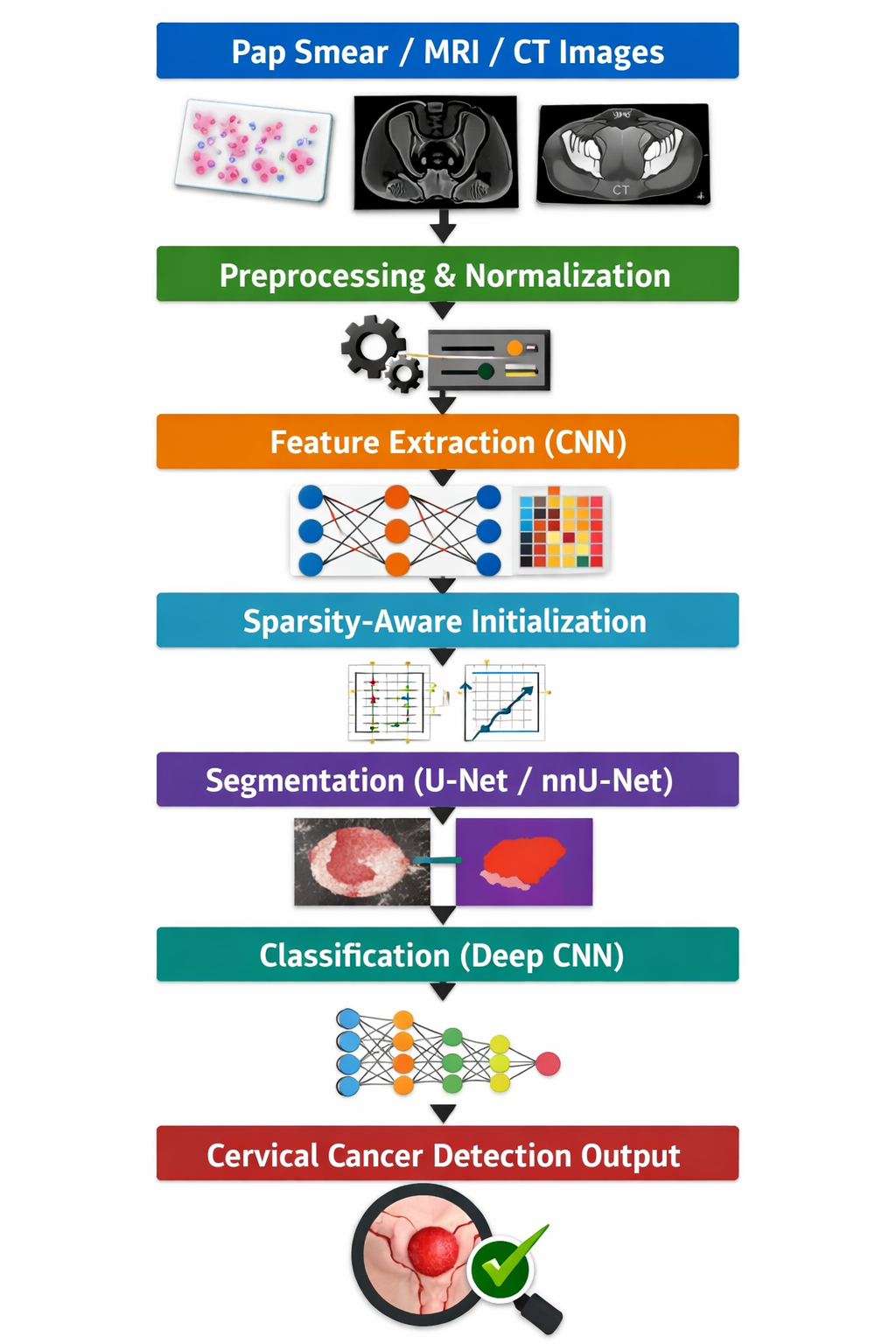
Cervical cancer remains a major public health concern and one of the leading causes of cancer-related deaths among women worldwide. Early diagnosis through screening methods such as Pap smear, HPV testing, and colposcopy is essential for improving survival rates, yet manual image analysis is labor-intensive, subjective, and prone to diagnostic variability. Recent advances in deep learning have enabled the development of automated systems for cervical cancer detection and segmentation, significantly enhancing diagnostic accuracy and efficiency. Convolutional neural networks (CNNs) have demonstrated excellent performance in cervical cell classification, while semantic segmentation architectures, including U-Net and nnU-Net, provide precise localization of tumor regions with high segmentation accuracy. Additionally, sparsity-aware orthogonal initialization (SAOI) has emerged as an effective optimization strategy that improves neural network convergence, reduces computational complexity, and enhances model scalability through efficient sparse weight initialization. This systematic review examines recent developments in automatic cervical cancer detection and segmentation, emphasizing deep learning architectures, segmentation frameworks, and SAOI-based optimization techniques. The review compares existing methods, discusses their strengths and limitations, and identifies current research challenges. The findings indicate that integrating advanced deep learning models with efficient optimization strategies can significantly improve diagnostic performance, computational efficiency, and clinical applicability, supporting the development of reliable AI-assisted cervical cancer screening systems.