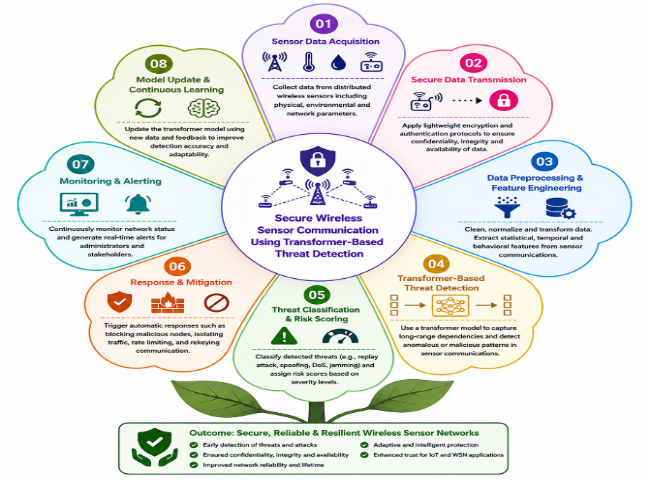
Secure Wireless Sensor Communication Using Transformer-Based Threat Detection
DOI:
https://doi.org/10.65521/ijacte.v15i2.3305Keywords:
Abstract
Wireless Sensor Networks (WSNs) have become fundamental components of modern smart environments, including healthcare systems, industrial automation, smart cities, environmental monitoring, military surveillance, and Internet of Things (IoT) applications. Despite their widespread adoption, wireless sensor networks remain highly vulnerable to various cyber threats such as denial-of-service attacks, sinkhole attacks, wormhole attacks, spoofing attacks, selective forwarding, and data manipulation. These security challenges can compromise communication integrity, confidentiality, availability, and overall network reliability. Traditional security mechanisms often struggle to detect sophisticated and evolving cyber threats due to limited adaptability and reliance on predefined attack signatures. Recent advances in artificial intelligence and deep learning have demonstrated significant potential for intelligent intrusion detection and network protection. This research proposes a Secure Wireless Sensor Communication Framework Using Transformer-Based Threat Detection (SWSC-TBTD) that integrates wireless communication analytics, transformer-based deep learning architectures, adaptive threat detection mechanisms, and intelligent security management strategies. The proposed framework utilizes self-attention mechanisms to capture long-range dependencies within network traffic and identify malicious communication patterns with high precision.