A Comprehensive Review of An Optimized Learning Network based Ictal and Interictal States of Automatic Seizure Detection Using Multi-Channel Scalp EEG
DOI:
https://doi.org/10.65521/ijacte.v13i1.3775Keywords:
Abstract
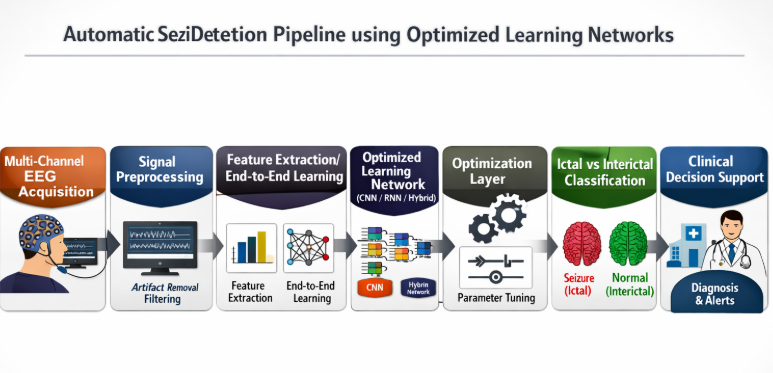
Automatic seizure detection using multi-channel scalp electroencephalography (EEG) has emerged as a crucial area of research in neurological disorder diagnosis, particularly for epilepsy management. The differentiation between ictal (seizure) and interictal (non-seizure) states remains a challenging task due to the complex, non-linear, and non-stationary nature of EEG signals. This paper presents a comprehensive review of optimized learning network approaches employed for automatic seizure detection, emphasizing advancements in deep learning, hybrid architectures, and optimization strategies. The study explores various signal processing techniques, including time-frequency analysis, feature extraction, and channel selection methods, which significantly influence model performance. Additionally, it examines the role of convolutional neural networks, recurrent neural networks, and attention-based mechanisms in capturing spatial-temporal EEG patterns. Optimization techniques such as genetic algorithms, particle swarm optimization, and adaptive learning frameworks are also reviewed to highlight their impact on improving detection accuracy and computational efficiency. The paper further discusses benchmark datasets, evaluation metrics, and real-world implementation challenges. By synthesizing findings from existing literature, this review aims to provide insights into current trends, limitations, and future research directions in seizure detection systems. The integration of optimized learning networks with multi-channel EEG analysis holds significant potential for developing reliable, real-time, and clinically applicable seizure detection solutions.