Recent Advances in CAE-Dual-Key Transformer-Based Smart E-Health for Tuberculosis Prediction: A Systematic Review
DOI:
https://doi.org/10.65521/ijacte.v12i2.3824Keywords:
Abstract
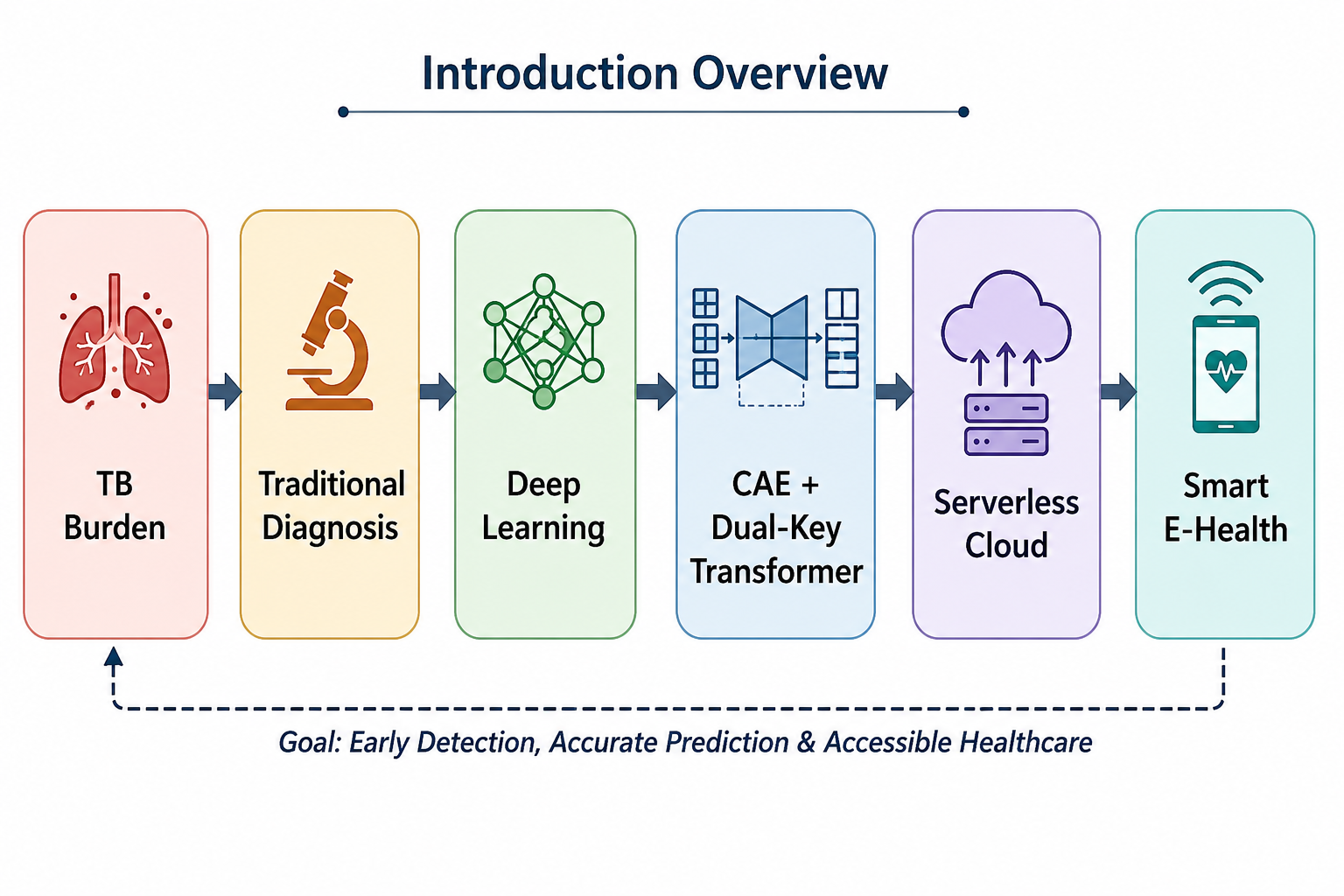
Tuberculosis (TB) remains one of the most critical infectious diseases worldwide, requiring early detection and efficient monitoring to reduce mortality rates. With the rapid evolution of artificial intelligence, deep learning techniques such as Convolutional Neural Networks (CNNs), Convolutional Autoencoders (CAE), and Transformer-based architectures have significantly improved medical image analysis and disease prediction. This paper presents a systematic review of recent advances in hybrid deep learning models, particularly focusing on Convolutional Autoencoder integrated with dual-key transformer networks for smart e-health applications. The study also explores the role of serverless cloud computing in enabling scalable, cost-effective, and real-time deployment of TB prediction systems. Recent studies demonstrate that transformer-based self-attention mechanisms enhance feature extraction by capturing global dependencies, while convolutional autoencoders effectively perform dimensionality reduction and noise filtering in medical imaging data. Furthermore, cloud-based architectures facilitate seamless integration of AI models with healthcare systems, improving accessibility and diagnostic efficiency. The review highlights the strengths, limitations, and future directions of these technologies, emphasizing multimodal data integration and explainable AI for clinical trust. Overall, the combination of CAE, transformer networks, and serverless cloud computing provides a promising framework for accurate, scalable, and intelligent TB prediction systems.