A Deep Learning-Based Intelligent Framework for Real-Time Network Traffic Classification and Anomaly Detection in Distributed Computing Systems
DOI:
https://doi.org/10.65521/ijacte.v15i2.4697Keywords:
Abstract
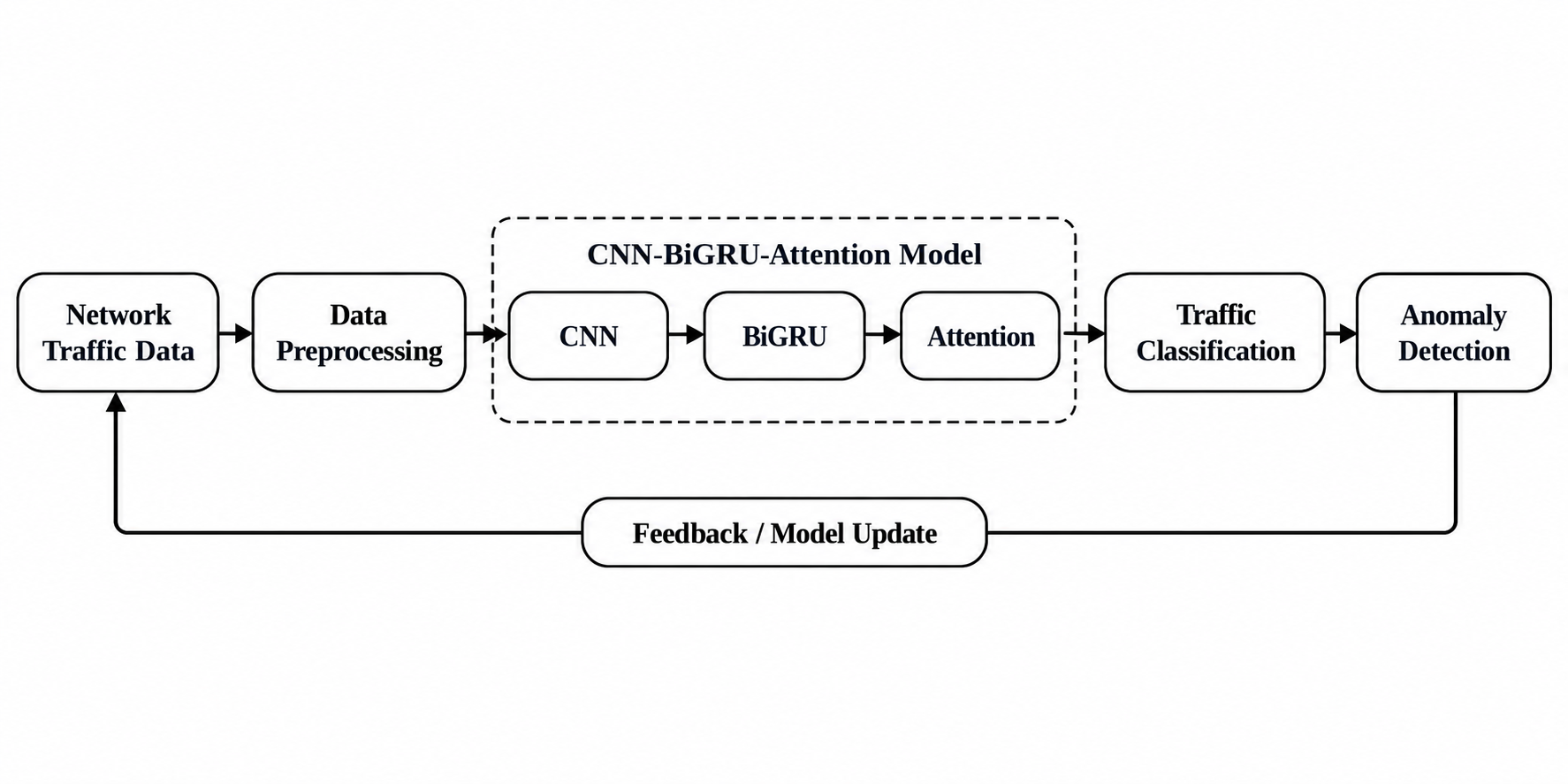
The increasing deployment of distributed computing systems, cloud platforms, edge networks, and interconnected digital services has significantly increased the complexity of network traffic monitoring and cybersecurity management. Conventional network traffic classification and anomaly detection techniques frequently encounter limitations associated with high-dimensional traffic data, evolving attack patterns, heterogeneous communication protocols, and strict real-time processing requirements. This study proposes a deep learning-based intelligent framework integrating a one-dimensional Convolutional Neural Network (1D-CNN), Bidirectional Gated Recurrent Unit (BiGRU), and temporal attention mechanism for network traffic classification and anomaly detection in distributed computing environments. The proposed architecture combines local feature extraction, sequential dependency modeling, and attention-based representation learning to distinguish legitimate network activity from suspicious traffic patterns. A distributed monitoring architecture is introduced in which network flow features are collected from geographically or logically separated computing nodes and processed using a centralized or edge-assisted inference service. The framework incorporates preprocessing, normalization, class imbalance management, temporal window construction, supervised classification, and anomaly score estimation. A reproducible experimental methodology is proposed using the CICIDS2017 and UNSW-NB15 datasets, with comparative evaluation against traditional machine learning and deep learning baselines. Performance measures include accuracy, precision, recall, macro-F1-score, false-positive rate, inference latency, and processing throughput. The proposed methodology additionally examines the effect of feature extraction, temporal modeling, and attention through ablation experiments. The study establishes an architectural and experimental foundation for investigating scalable, intelligent network traffic monitoring, while empirical validation is required to determine its detection effectiveness and real-time suitability.