
Long-Range Through-Wall Human Activity Recognition from WiFi Channel State Information Using a Lightweight Convolutional-Transformer-Recurrent Model
DOI:
https://doi.org/10.65521/ijacect.v15i2.4801Keywords:
Abstract
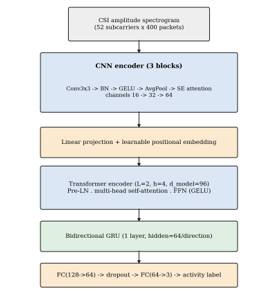
Device-free human activity recognition (HAR) from WiFi channel state information (CSI) is attractive for smart indoor environments because it reuses existing wireless infrastructure, needs no wearable device, and avoids the privacy concerns of cameras. Long-range and through-wall sensing is a particularly demanding setting, since the signal is weaker and more attenuated than in direct line-of-sight (LOS) deployments. This paper proposes WiTransNet-Lite, a lightweight hybrid architecture that combines a convolutional encoder with squeeze-and-excitation attention, a compact Transformer encoder, and a bidirectional gated recurrent unit (BiGRU) layer, for activity recognition from CSI amplitude spectrograms. The model is evaluated on the public Wallhack1.8k dataset, which contains CSI amplitude spectrograms for three activity classes (no presence, walking, and walking with arm-waving) collected with a biquad-antenna WiFi system across line-of-sight and through-wall, multi-room scenarios, using the dataset's official training, validation, and test splits. WiTransNet-Lite, with 0.33 M parameters, reaches 77.3% test accuracy and a macro F1-score of 0.77, compared with 56.8% accuracy and a macro F1-score of 0.56 for a logistic-regression baseline on raw pixel features, and 27.3% for a majority-class baseline. An ablation study shows that removing the Transformer encoder reduces test accuracy by 22.7 percentage points and removing the BiGRU layer reduces it by 6.8 points, indicating that both components contribute. Inference latency is 6.2 ms per sample on a single CPU core. These results are obtained on a public benchmark with an official split and no baseline or model published in this paper claims state-of-the-art status; the study is presented as a reproducible, modestly scaled evaluation of a lightweight CNN–Transformer–GRU design for through-wall CSI sensing, with clearly stated limitations regarding dataset size and generalization.
Downloads
Published
How to Cite
Issue
Section
License

This work is licensed under a Creative Commons Attribution-NoDerivatives 4.0 International License.
