
A Survey on Intelligent Surveillance Systems for Classification of Usual and Unusual Events Using Deep Learning Models
Keywords:
Abstract
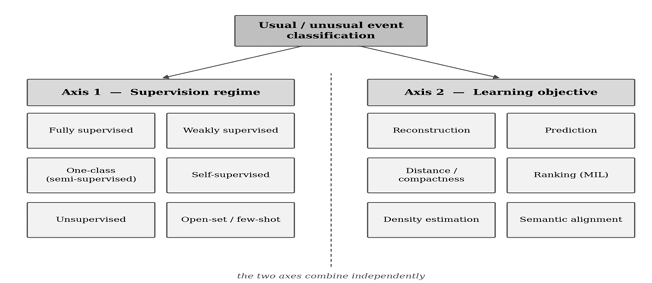
The proliferation of closed-circuit television and networked camera infrastructure has outpaced the human capacity to monitor it, motivating sustained research into intelligent surveillance systems capable of distinguishing usual from unusual events automatically. Over the past decade the field has migrated decisively from handcrafted motion and appearance descriptors towards deep representation learning, and more recently towards weakly supervised, self-supervised, and vision–language paradigms. This survey provides a critical and comparative examination of that trajectory, drawing on more than ninety studies published principally between 2019 and 2026 together with a smaller set of earlier works that remain foundational. The classification problem is first formalised, and it is established that the field employs at least four distinct and only partially compatible problem definitions, a circumstance that materially complicates cross-study comparison. A two-axis taxonomy organised by supervision regime and by learning objective is then proposed and used to structure a detailed analysis of reconstruction-based, prediction-based, memory-augmented, adversarial, graph-based, transformer-based, and vision–language architectures. Particular attention is given to the weakly supervised multiple-instance paradigm, which now dominates work on real-world untrimmed footage. The principal benchmarks and evaluation protocols are consolidated, and it is argued that the widespread reliance on frame-level area under the receiver operating characteristic curve has produced an appearance of saturation that conceals persistent weaknesses in localisation, generalisation, and false-alarm behaviour. Comparative performance tables are presented alongside an analysis of the experimental conditions that govern their comparability. The survey closes by identifying research gaps relating to scene dependence, dataset bias, domain shift, explainability, adversarial robustness, and deployment under edge and fog computing constraints, and by outlining the directions that appear most promising for the next phase of the field.
Downloads
Published
How to Cite
Issue
Section
License

This work is licensed under a Creative Commons Attribution-NoDerivatives 4.0 International License.
