
Feature Drift Aware Boosted Ensemble with Feature Set Management in Concept Drift Analysis for Academic Data
DOI:
https://doi.org/10.65521/ijacect.v14i3s.1638Keywords:
Abstract
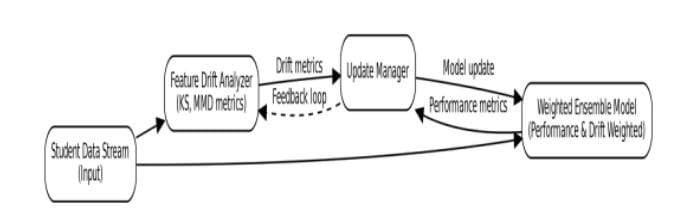
Predictive modelling in education has become a cornerstone of learning analytics, supporting student performance forecasting, early identification of at-risk learners, and adaptive curriculum design. However, these models often suffer degradation due to concept drift, the phenomenon where the joint distribution of features and outcomes evolves over time. In academic settings, drift arises from shifting curricula, new teaching modalities, grading policy changes, and evolving student behaviors, making drift adaptation a pressing research challenge. While much of the literature addresses global model retraining, recent advances highlight the importance of feature drift—distributional changes localized to specific input features or feature groups. Blind retraining can lead to unnecessary computational costs and “overfixing” of stable features, whereas feature-level management allows for more targeted, efficient adaptations. This paper reviews the past decade’s progress in drift detection and adaptation, emphasizing feature-wise strategies in supervised learning models. We then propose a novel framework, Feature Drift-Aware Boosted Ensemble for Education (FDABE-Edu), an ensemble-based architecture designed to detect, isolate, and adapt to drifting features in academic data streams. FDABE-Edu incorporates a continuous Feature Drift Analyzer, a Weighted Ensemble that prioritizes stable features while down-weighting volatile ones, and an Update Manager for iterative recalibration. The framework leverages statistical and performance feedback to dynamically adjust drift thresholds and retrain only where necessary. A pseudo-code implementation, system flowcharts, and architectural diagrams are provided to demonstrate feasibility. Comparative analysis situates FDABE-Edu alongside state-of-the-art drift handling algorithms, illustrating its novelty in academic contexts. Finally, we discuss emerging research avenues, including hierarchical drift detection, semi-supervised learning with delayed labels, fairness-aware adaptation, and causal inference integration. By bridging feature-level analysis with ensemble learning, FDABE-Edu advances the development of robust, adaptive, and transparent predictive systems for evolving educational environments.
Downloads
Published
How to Cite
Issue
Section
License

This work is licensed under a Creative Commons Attribution-NoDerivatives 4.0 International License.
