Machine Learning Approaches for Cybersecurity Threat Detection and Prevention
Keywords:
Abstract
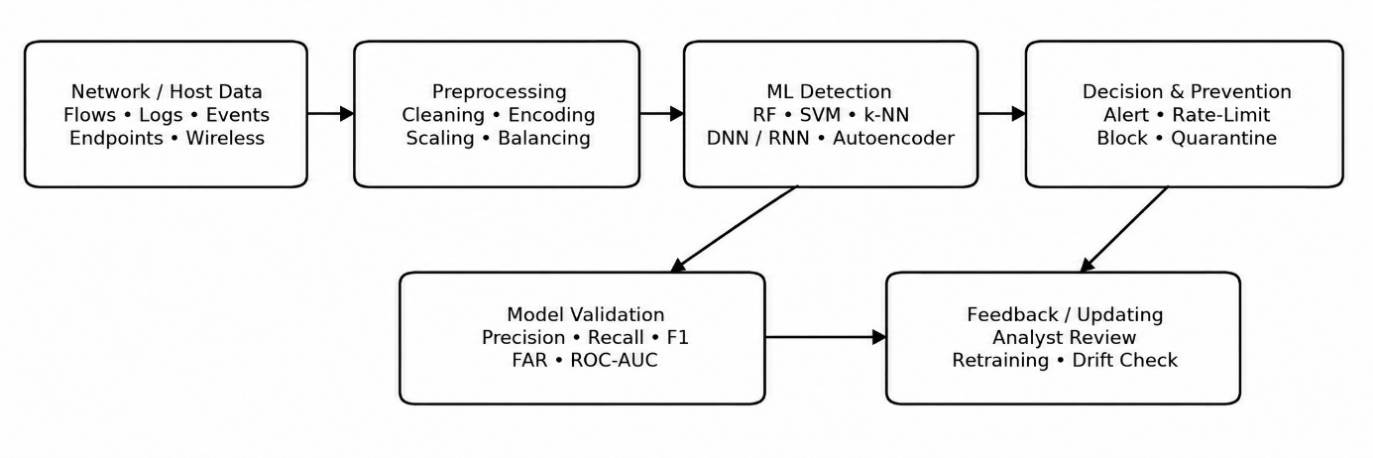
Cybersecurity monitoring generates large volumes of network flows, system events and endpoint logs that are difficult to analyze using signatures alone. Machine learning (ML) offers a complementary approach by learning statistical patterns of normal and malicious behavior and assigning risk scores to previously unseen events. This methodology paper develops a reproducible framework for evaluating ML approaches for cybersecurity threat detection and prevention using references published up to 2019. The design compares supervised classifiers such as Random Forest, Support Vector Machine (SVM), k-nearest neighbors (k-NN) and Gradient Boosting with deep models including deep neural networks (DNNs), recurrent neural networks (RNNs) and unsupervised autoencoder-based anomaly detection. The study uses modern benchmark data, principally UNSW-NB15 and CICIDS2017, because older datasets can poorly represent contemporary traffic and attacks. Earlier work established anomaly detection as a central cybersecurity technique, while later research demonstrated both the promise and deployment challenges of machine learning in operational intrusion detection (Sommer & Paxson, 2010; Buczak & Guven, 2016). Deep-learning studies further showed that RNNs, autoencoders and distributed DNNs can learn complex attack patterns. The proposed experiment evaluates accuracy, precision, recall, F1-score, false-alarm rate, ROC-AUC, detection latency and inference throughput under binary and multiclass settings. A controlled prevention layer converts only high-confidence predictions into actions such as alerting, rate limiting, temporary blocking or host quarantine, with analyst review for destructive actions. Because no raw experimental outputs were supplied, numerical results are presented only as illustrative expected patterns and not as fabricated findings. The framework is intended to support accurate, low-false-alarm and operationally safe ML-assisted cyber defense.