Artificial Intelligence-Based Traffic Management System Using Edge Computing
Keywords:
Abstract
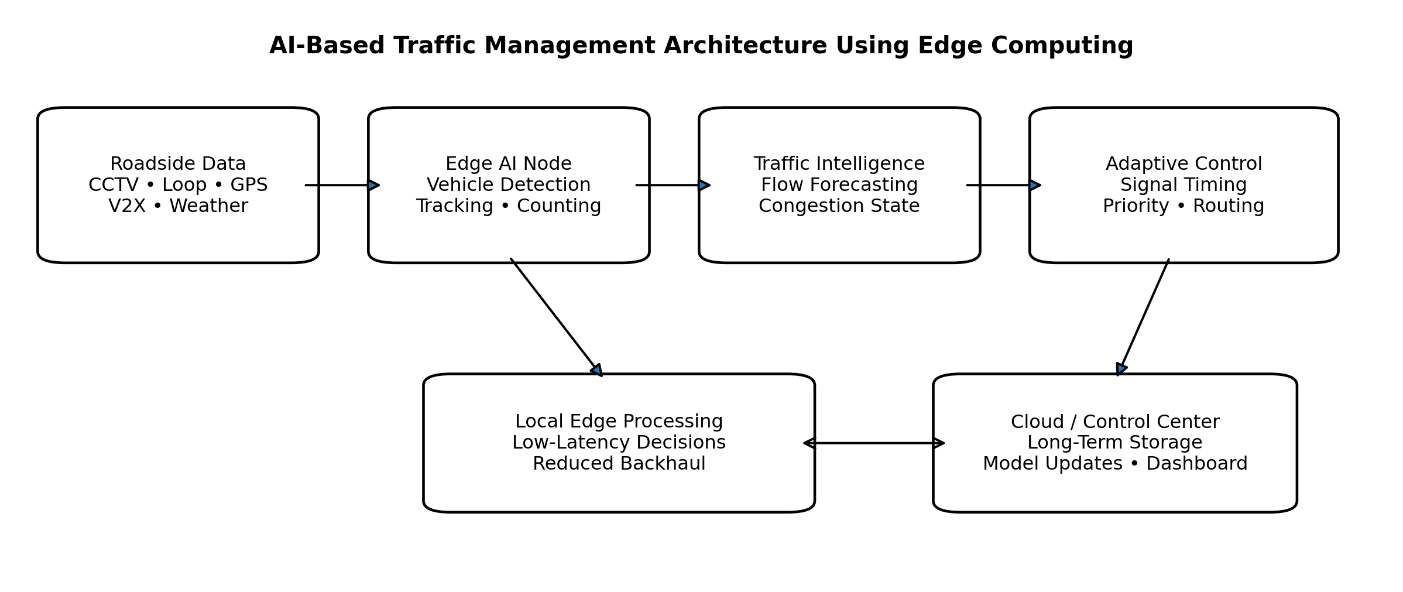
Urban traffic management increasingly depends on real-time sensing, fast analytics and adaptive control. Cloud-only architectures can introduce communication delay, bandwidth consumption and privacy concerns when continuous camera and sensor streams must be transmitted to remote servers. Edge computing addresses these limitations by placing computation near intersections, roadside units and traffic cameras, while artificial intelligence (AI) enables vehicle detection, traffic-flow prediction and dynamic signal optimization. This methodology paper develops a reproducible framework for evaluating an AI-based traffic management system using edge computing. The proposed system combines real-time vehicle detection, short-term traffic prediction and deep-reinforcement-learning-based signal control at edge nodes, with the cloud retained for long-term storage, dashboarding and model updates. The design is grounded in established research on edge computing (Shi et al., 2016), real-time object detection (Redmon et al., 2016), graph-based traffic forecasting (Zhang et al., 2019; Guo et al., 2019), adaptive traffic-signal control using deep reinforcement learning (Wang et al., 2019; Gong et al., 2019; Li et al., 2020), and edge-enabled intelligent transportation systems (Zhou et al., 2021; Paul & Mitra, 2022). A simulation-and-prototype methodology is proposed using SUMO for road-traffic generation, Python-based AI models for perception and forecasting, and an edge node such as an NVIDIA Jetson or equivalent computing device. Performance is assessed through vehicle-detection accuracy, inference latency, prediction error, average waiting time, travel time, queue length, throughput, packet/network delay and edge resource utilization. Because no raw experimental dataset was supplied, the Results section reports illustrative expected patterns rather than fabricated empirical findings. The proposed methodology provides a compact framework for testing whether edge intelligence can reduce decision latency and improve traffic efficiency under changing urban demand.