Development of a Real-Time Face Recognition System Using Image Processing Techniques
Keywords:
Abstract
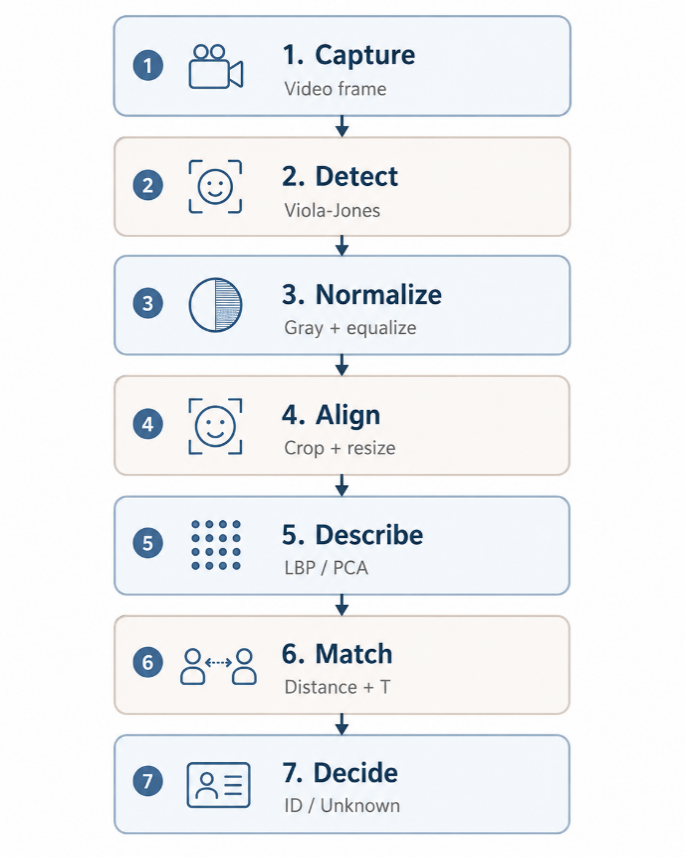
Face recognition is a biometric image-analysis task in which a person is identified or verified from facial appearance. This methodology paper presents a practical architecture for developing a real-time face recognition system using image processing techniques available by 2016. The design emphasizes computational efficiency and interpretability rather than a large deep-learning model. Video frames are acquired from a camera, faces are localized using the Viola-Jones boosted cascade, and detected regions are converted to grayscale, normalized, aligned, and resized. Local Binary Pattern (LBP) histograms provide the principal texture descriptor, while Principal Component Analysis (PCA) is retained as a compact baseline representation. Recognition is performed by comparing an incoming feature vector with enrolled templates using a distance measure and a decision threshold. The paper specifies enrollment, real-time processing, threshold calibration, evaluation metrics, and failure-handling procedures. Earlier eigenface, Fisherface, FERET, LBP, and real-time detection studies establish the classical foundation, while DeepFace, FaceNet, and other pre-2016 work demonstrate the performance frontier that motivated better alignment and representation. Because the present work is methodological, reported performance values are stated as transparent prototype targets rather than fabricated experimental measurements. The resulting design is suitable for attendance, access control, laboratory monitoring, and other controlled-camera applications where low latency and straightforward implementation are important.