IoT-Enabled Demand Response Framework for Cost-Efficient Smart Energy Systems
Keywords:
Abstract
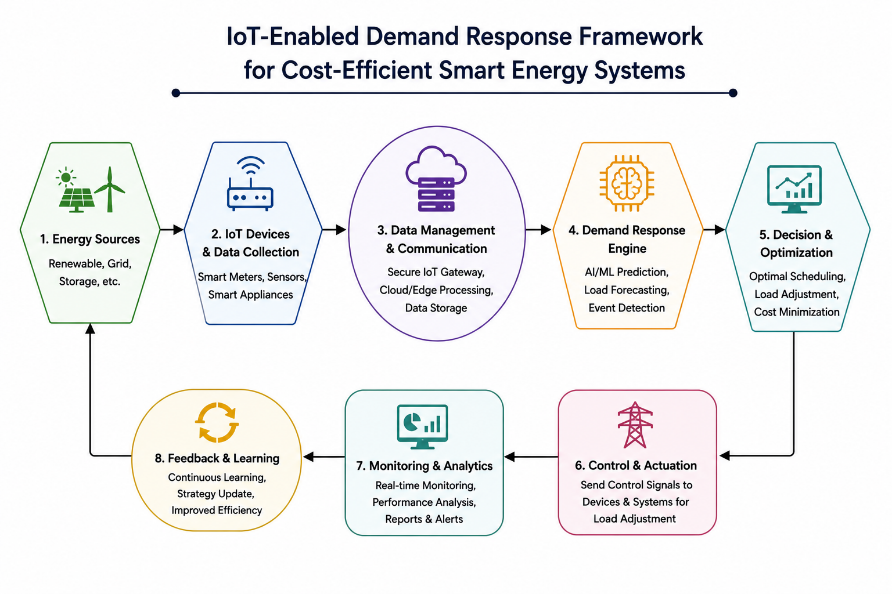
The rapid growth of smart grids, Internet of Things (IoT) technologies, and distributed energy resources has transformed traditional power systems into intelligent and interconnected energy ecosystems. Demand Response (DR) programs have emerged as an effective solution for balancing electricity demand and supply while reducing operational costs and improving grid reliability. However, conventional demand response mechanisms often face challenges related to limited real-time monitoring, inefficient load management, delayed decision-making, and insufficient consumer participation. To address these limitations, this research proposes an IoT-Enabled Demand Response Framework for Cost-Efficient Smart Energy Systems (IDRF-CSES). The framework integrates IoT-based energy monitoring, real-time demand forecasting, intelligent load scheduling, adaptive consumer engagement, and cost optimization mechanisms to improve energy efficiency and grid performance. The proposed framework utilizes smart meters, IoT sensors, cloud-based analytics, and machine learning algorithms to continuously monitor energy consumption patterns and dynamically adjust electricity demand according to pricing signals and grid conditions. Intelligent scheduling and automated control mechanisms optimize energy utilization while minimizing electricity costs and peak demand.