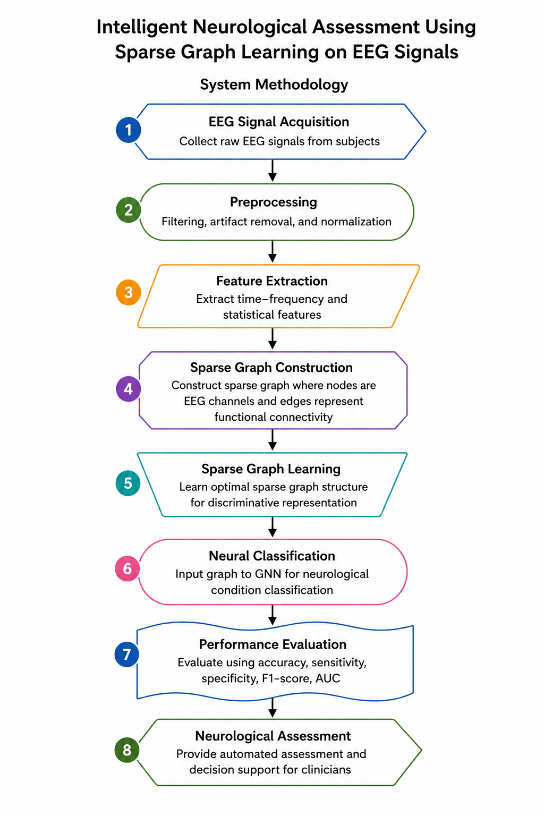
Intelligent Neurological Assessment Using Sparse Graph Learning on EEG Signals
Keywords:
Abstract
Neurological disorders such as epilepsy, Parkinson’s disease, and cognitive impairment require accurate and early diagnosis for effective treatment and management. Electroencephalography (EEG) provides a non-invasive method to capture brain electrical activity; however, EEG signals are inherently noisy, high-dimensional, and exhibit complex spatial-temporal dependencies, making automated neurological assessment challenging. This study proposes an Intelligent Neurological Assessment framework using Sparse Graph Learning (SGL) on EEG signals. The proposed model represents EEG channels as graph nodes and learns sparse connectivity patterns that reflect functional brain interactions. A graph learning mechanism is employed to construct adaptive adjacency matrices, while deep graph neural networks extract meaningful spatial-temporal representations. The sparsity constraint improves computational efficiency and reduces redundant connections, enhancing interpretability and robustness. The proposed framework is evaluated on standard EEG datasets, and performance is measured using accuracy, sensitivity, specificity, F1-score, and ROC-AUC. Experimental results demonstrate that the sparse graph learning approach significantly outperforms conventional machine learning and deep learning models. The framework is well-suited for real-time neurological diagnosis and clinical decision-support systems.