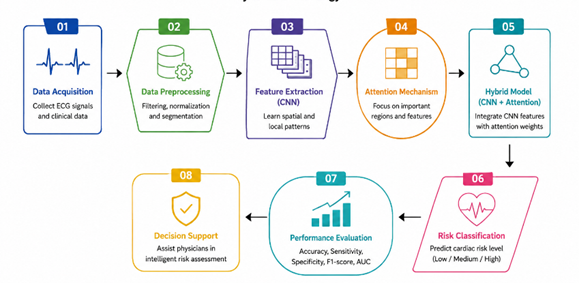
Hybrid Convolutional Attention Models for Intelligent Cardiac Risk Assessment
Keywords:
Abstract
Cardiovascular diseases remain the leading cause of global mortality, necessitating advanced intelligent systems for early and accurate cardiac risk assessment. Traditional risk prediction methods often rely on static clinical parameters and fail to capture complex nonlinear interactions present in physiological signals. To address these limitations, this study proposes a Hybrid Convolutional Attention Model (HCAM) for intelligent cardiac risk assessment using electrocardiographic and clinical data. The proposed framework integrates Convolutional Neural Networks (CNNs) for local feature extraction with attention mechanisms to enhance feature weighting and interpretability. The CNN module captures spatial dependencies in cardiac signals, while the attention layer dynamically focuses on the most relevant physiological patterns contributing to cardiac risk. This hybrid architecture improves both predictive accuracy and model interpretability, making it suitable for clinical decision support systems. The model is evaluated using standard cardiovascular datasets, and performance is measured in terms of accuracy, precision, recall, F1-score, and ROC-AUC. Experimental results demonstrate that the proposed HCAM significantly outperforms conventional machine learning models and standard deep learning architectures. The findings highlight the potential of attention-based deep learning models in improving early cardiac risk detection and supporting preventive healthcare systems.