
Comparative Evaluation of CNN–Autoencoder with existing models for Security Threat Detection in Cloud Environments
DOI:
https://doi.org/10.65521/ijacect.v14i2.1845Keywords:
Abstract
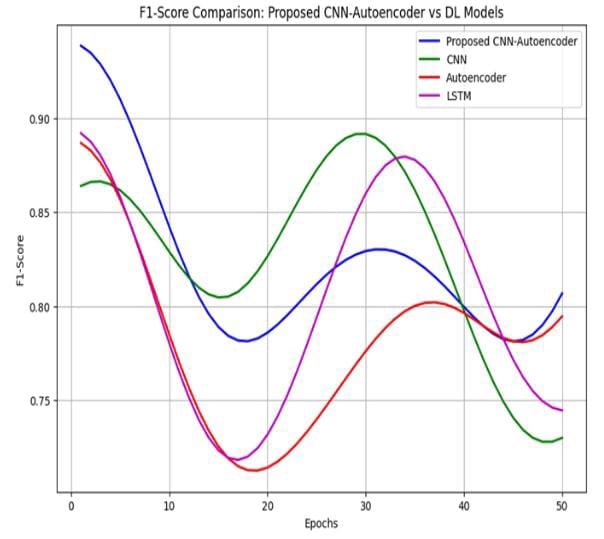
The growing number of complexity and size of cloud computing environments has preconditioned them being the target of numerous security threats, such as Distributed Denial of service (DDoS) attacks, data breaches, and insider threats. The conventional Intrusion Detection System (IDS) is usually not sufficient in managing these advanced threats because it cannot cope with the new patterns of attack and volume of data. The hybrid CNN-Autoencoder model that we suggest in the current paper will overcome these difficulties by incorporating Convolutional Neural Networks (CNN) to extract the features on the network traffic and system logs, and Autoencoders to detect anomalies based on reconstruction error. The model is compared to other deep learning-based IDS models (CNN, Autoencoder and LSTM) in detection accuracy, scalability and resilience in dynamic cloud environments. Experimental findings indicate that the proposed model is more effective compared with the existing models in terms of accuracy, precision, recall, F1-score, and AUC (Area Under Curve), thus it is a very effective solution to real-time security threat detection. Also, the optimization strategies of the model, such as the hyperparameter optimization, feature selection, and model regularization, make the model highly performing, and at the same time, computationally efficient.
Downloads
Published
How to Cite
Issue
Section
License

This work is licensed under a Creative Commons Attribution-NoDerivatives 4.0 International License.
