
AI In Health Care
Keywords:
Abstract
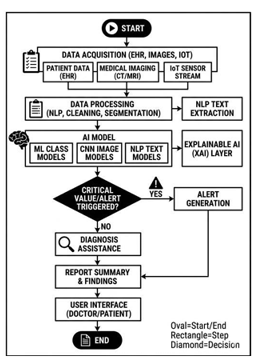
Artificial Intelligence (AI) is playing a major role in improving the healthcare sector. It helps doctors make more accurate diagnoses, choose better treatments for patients, and manage hospital work more efficiently. AI works by using algorithms and machine learning techniques that can mimic human thinking abilities such as learning from data and making decisions. One of the most important uses of AI is in medical imaging. AI systems can study images like X-rays, MRIs, and CT scans to identify problems such as tumors or bone fractures with high precision. This reduces human error and speeds up the diagnosis process. AI is also useful in predicting diseases. By analyzing patient data, it can identify individuals who are at high risk of certain conditions. This allows doctors to take preventive actions at an early stage, improving patient outcomes. In personalized medicine, AI helps doctors create treatment plans based on a patient’s unique data, including their medical history and genetic information. This approach is especially helpful in cancer treatment, where choosing the right therapy is very important. Another important area is Natural Language Processing (NLP). NLP allows computers to understand and organize medical records and clinical notes, making it easier for healthcare professionals to quickly access important information. AI-powered chatbots and virtual assistants are also becoming common. They can answer patient questions, check symptoms, and help with scheduling appointments at any time of the day, reducing the workload on hospital staff. In addition, AI is helping in faster drug discovery. Machine learning models can study large amounts of medical and chemical data to predict how effective a new drug might be, which speeds up the research process. Finally, AI-based wearable devices like ECG monitors are used for remote patient monitoring. These devices track important health data and alert doctors if there are any unusual changes, allowing timely medical intervention and better patient care.
Downloads
Published
How to Cite
Issue
Section
License

This work is licensed under a Creative Commons Attribution-NoDerivatives 4.0 International License.
