A Comprehensive Review of Similarity-Navigated Graph Neural Networks and Lightweight Cryptography for Preventing Black Hole Attacks in MANET
Keywords:
Abstract
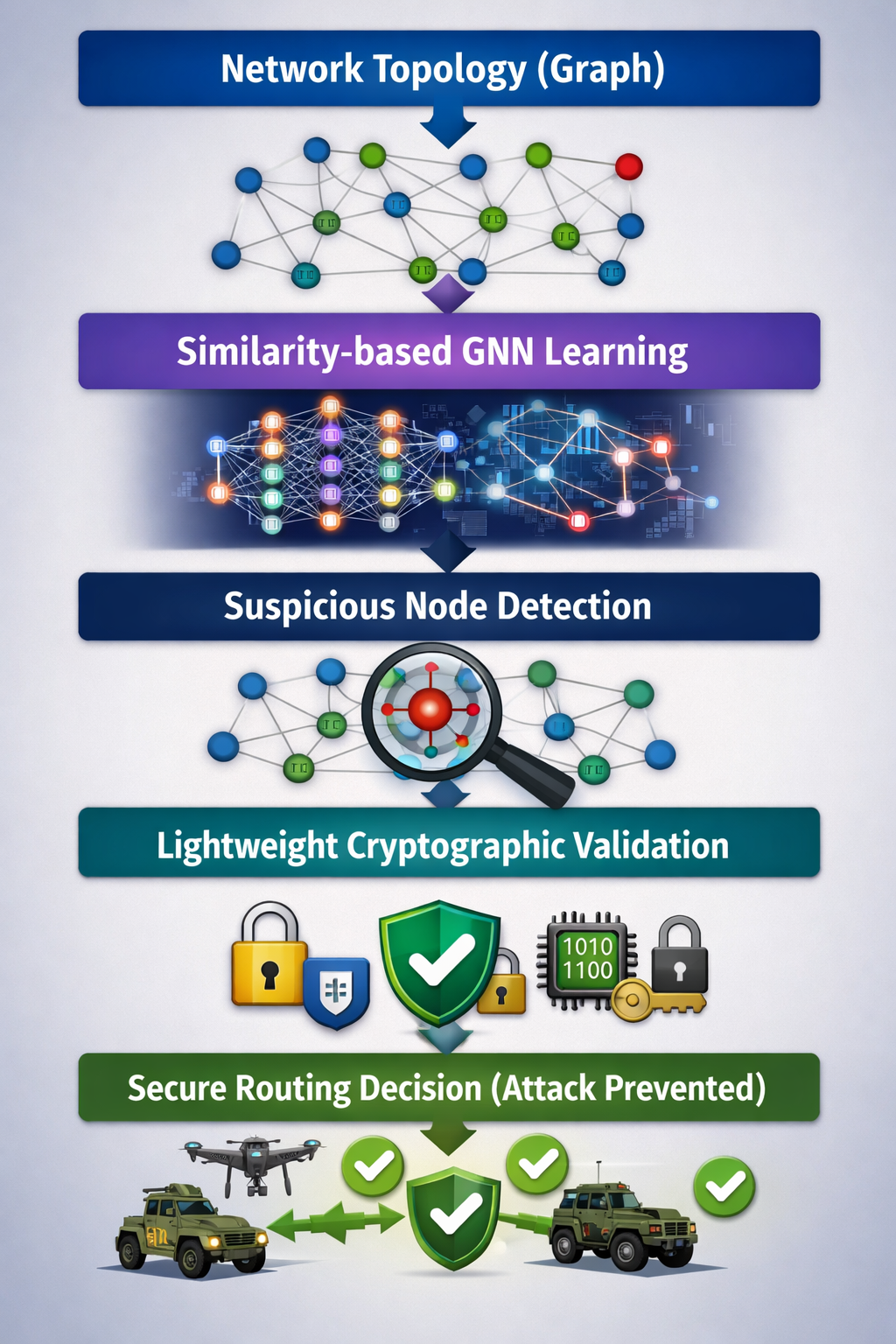
Mobile Ad Hoc Networks (MANETs) are decentralized and infrastructure-less wireless systems that enable dynamic communication among mobile nodes. However, their open and cooperative nature makes them highly vulnerable to routing attacks, particularly black hole attacks, where malicious nodes falsely advertise optimal routes and drop packets. Recent advancements in artificial intelligence, especially Graph Neural Networks (GNNs), have demonstrated significant potential in modeling network topology and detecting anomalous behavior. Additionally, lightweight cryptographic mechanisms have emerged as efficient solutions to ensure security while maintaining low computational overhead in resource-constrained MANET environments. This paper presents a comprehensive review of similarity-navigated GNN architectures combined with lightweight cryptography techniques for mitigating black hole attacks. The study analyzes recent literature, highlighting approaches such as anomaly detection using machine learning, trust-based routing, and cryptographic authentication. Comparative analysis reveals that hybrid frameworks integrating GNN-based similarity learning with lightweight encryption provide improved detection accuracy, reduced delay, and enhanced packet delivery ratio. The paper also identifies research gaps, including scalability challenges, adversarial robustness, and energy efficiency. Finally, future directions for secure MANET design using intelligent and cryptographic techniques are discussed.