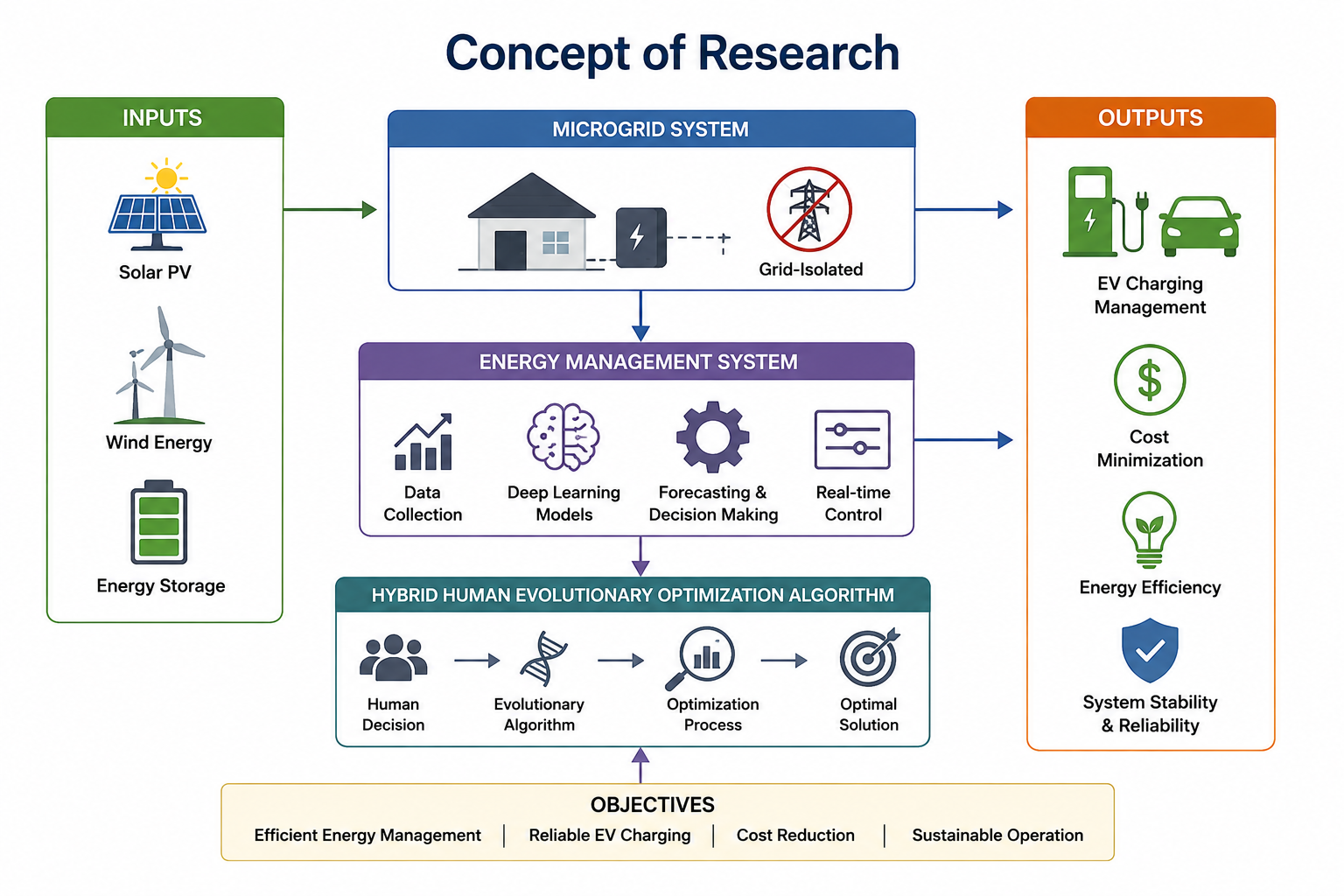
Deep Learning and Optimization Approaches in Energy Management in Microgrids: A Hybrid Human Evolutionary Optimization Algorithm for Grid-Isolated Electric Vehicle Charging Systems: A Review
Keywords:
Abstract
The integration of renewable energy sources and electric vehicles (EVs) into microgrid systems has introduced significant challenges in energy management, particularly in grid-isolated environments. Deep learning and optimization approaches have emerged as powerful tools for addressing these challenges by enabling intelligent decision-making, demand forecasting, and real-time control. This paper presents a comprehensive review of deep learning and optimization techniques for energy management in microgrids, with a focus on hybrid human evolutionary optimization algorithms for EV charging systems. Recent advancements highlight the growing adoption of artificial intelligence (AI)-based models, including convolutional neural networks (CNN), long short-term memory (LSTM), reinforcement learning (RL), and hybrid evolutionary algorithms. These techniques have demonstrated improved performance in terms of energy efficiency, cost reduction, and system stability. The study analyses 30 research works and categorizes them based on methodologies such as traditional optimization, machine learning, deep learning, and hybrid AI approaches. A comparative analysis reveals that hybrid models combining deep learning with evolutionary optimization provide superior results compared to standalone techniques. However, challenges such as computational complexity, uncertainty in renewable generation, and lack of real-time deployment persist. Future research directions emphasize lightweight deep learning models, decentralized control strategies, and integration with edge computing for real-time energy management in grid-isolated EV charging systems.