Recent Advances in Hybrid Graph Neural Networks for Wearable IoT Monitoring Systems with Adaptive Algorithms and Energy-Efficient WSN Integration: A Systematic Review
Keywords:
Abstract
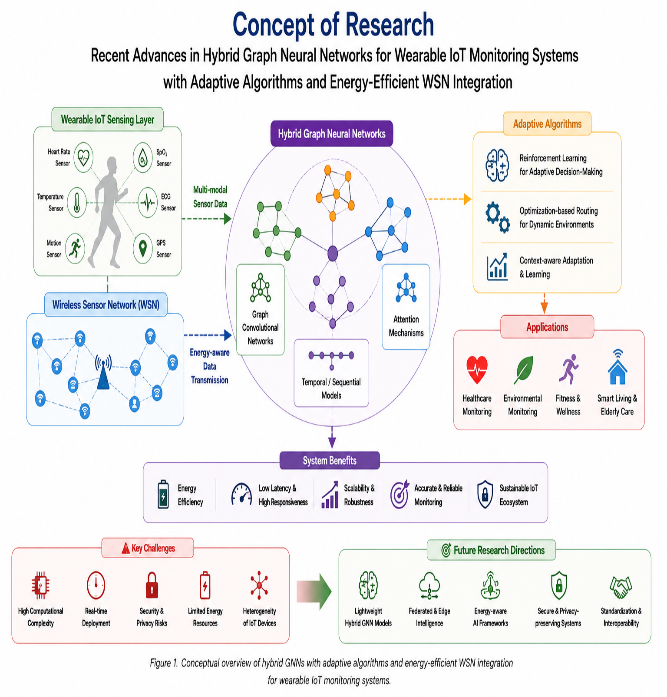
Wearable Internet of Things monitoring systems have transformed healthcare, environmental sensing, and smart living applications by enabling continuous real-time data collection. However, the increasing complexity of interconnected sensor networks introduces challenges related to scalability, energy efficiency, and adaptive decision-making. Graph Neural Networks have emerged as a powerful solution for modelling complex relationships in IoT systems due to their ability to capture dependencies among interconnected nodes. This paper presents a comprehensive review of recent advances in hybrid Graph Neural Networks for wearable IoT monitoring systems integrated with adaptive algorithms and energy-efficient Wireless Sensor Networks. Hybrid GNN architectures combining convolutional, attention-based, and temporal models have shown significant improvements in handling dynamic IoT data and optimizing network performance. These models enable efficient processing of multi-modal sensor data while maintaining scalability and robustness. Adaptive algorithms such as reinforcement learning and optimization-based routing have been integrated with GNNs to improve decision-making in dynamic environments. These approaches enhance system responsiveness and reduce latency in wearable IoT applications. Additionally, energy-efficient WSN integration has become a critical focus, with AI-driven routing and optimization techniques significantly improving network lifetime and reducing power consumption. Despite these advancements, challenges such as computational complexity, real-time deployment, and security vulnerabilities persist. This review focuses on developments, highlighting key trends, methodologies, and future research directions. The integration of hybrid GNNs with adaptive and energy-aware frameworks is expected to play a crucial role in next-generation intelligent IoT systems.