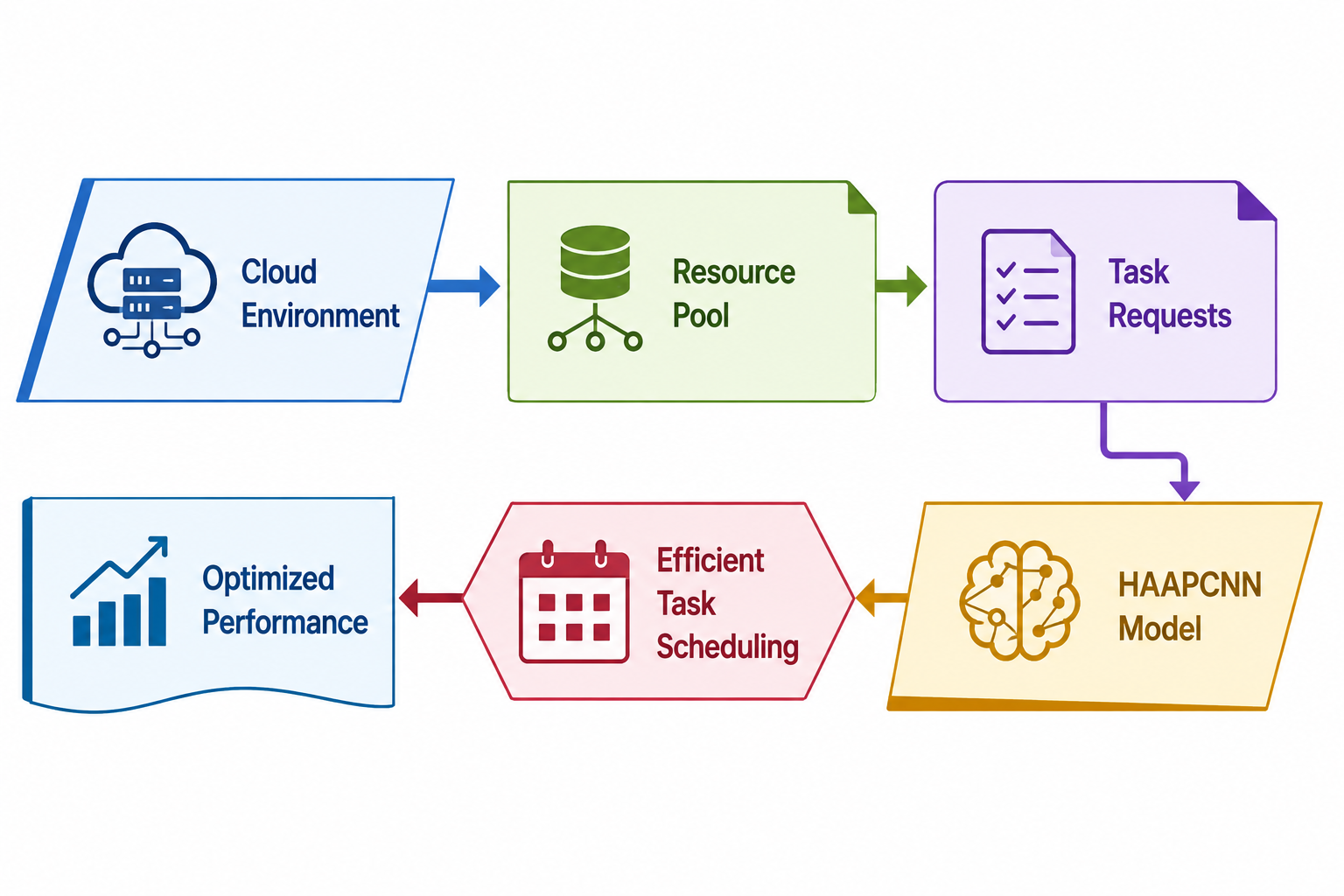
A Comprehensive Review of Resource Allocation with Efficient Task Scheduling in Cloud Computing Using Hierarchical Auto-Associative Polynomial Convolutional Neural Network
Keywords:
Abstract
Cloud computing has revolutionized modern computing by providing scalable, on-demand resources for diverse applications. However, efficient resource allocation and task scheduling remain critical challenges due to dynamic workloads, heterogeneous resources, and quality of service (QoS) requirements. Traditional scheduling algorithms often fail to adapt to real-time changes, leading to increased latency, resource underutilization, and higher operational costs. Recently, Artificial Intelligence (AI) and deep learning techniques have emerged as powerful solutions for optimizing cloud resource management. Convolutional Neural Networks (CNN), reinforcement learning, and hybrid optimization approaches have demonstrated improved performance in scheduling tasks and allocating resources efficiently. For instance, hybrid CNN-LSTM models optimized with bio-inspired algorithms have shown significant improvements in throughput and make span reduction. Similarly, advanced approaches such as RA-HAPCNN integrate hierarchical polynomial CNN architectures with optimization strategies to enhance resource utilization and scheduling efficiency. Deep reinforcement learning has also been widely explored for adaptive scheduling in dynamic cloud environments, offering improved decision-making capabilities. Despite these advancements, challenges such as computational complexity, scalability, and real-time adaptability persist. This review provides a comprehensive analysis of AI-based resource allocation and task scheduling techniques, focusing on hierarchical auto-associative polynomial convolutional neural networks and their role in improving cloud performance.