A Comprehensive Review of Energy Management System for Electric Vehicle with Solar and Wind Using Red Panda and Similarity-Navigated Graph Neural Network
Keywords:
Abstract
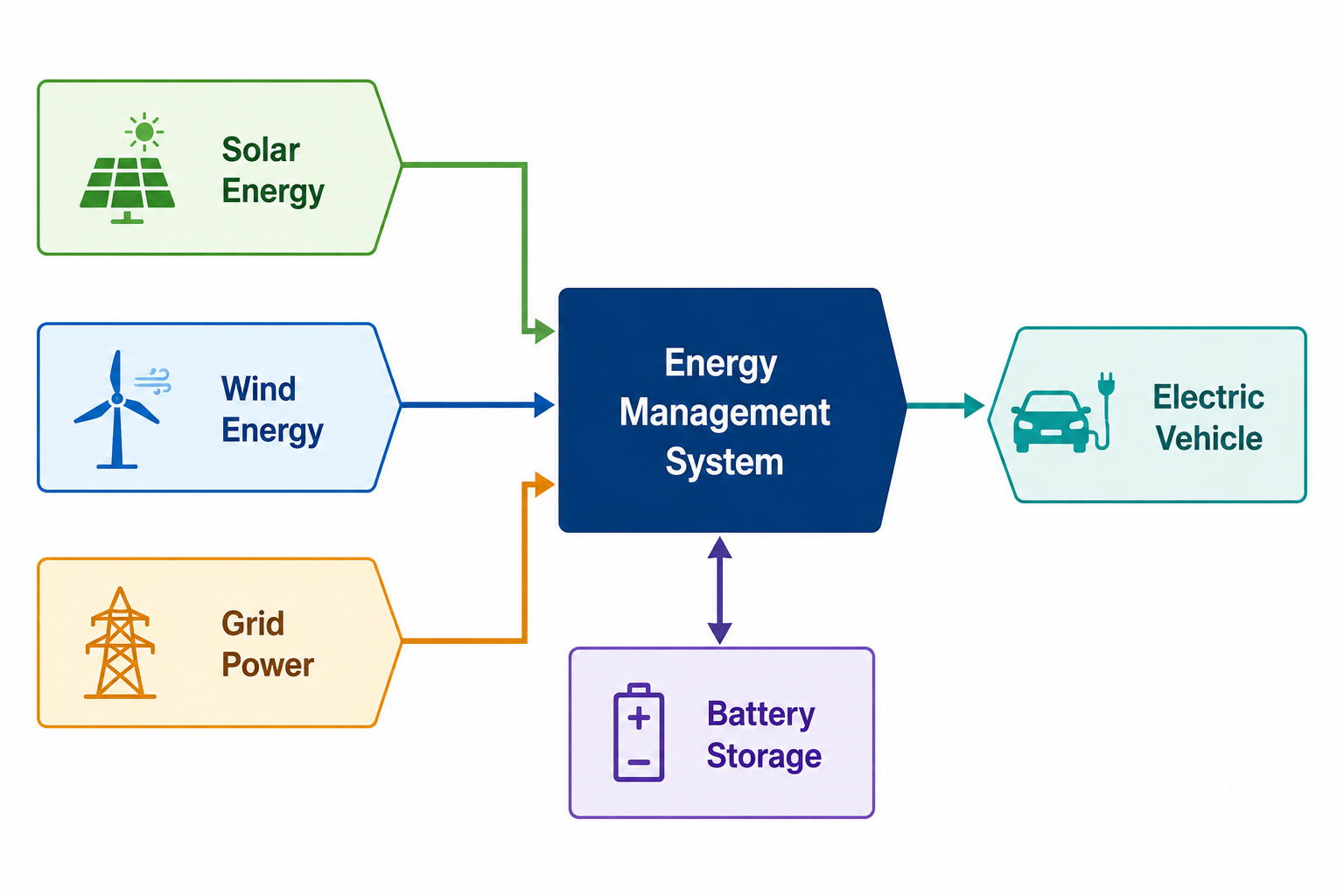
The transition toward sustainable transportation and renewable energy integration has intensified the need for intelligent energy management systems capable of coordinating electric vehicles, solar photovoltaic systems, wind energy, and grid infrastructure. These systems must address complex, dynamic, and stochastic interactions while optimizing energy efficiency, cost, battery health, and grid stability under uncertain operating conditions. This paper presents a comprehensive review of advanced energy management frameworks integrating the Red Panda Optimization algorithm with Similarity-Navigated Graph Neural Networks. The Red Panda algorithm, inspired by adaptive foraging behavior, provides effective global optimization with dynamic exploration–exploitation balance, while the graph neural network captures spatial and temporal dependencies within energy systems. The similarity-based attention mechanism enhances prediction accuracy by leveraging historical patterns, enabling improved forecasting, state estimation, and decision-making in renewable-integrated EV systems. Applications include vehicle-to-grid and vehicle-to-home systems, renewable energy scheduling, and intelligent power dispatch in smart grids. Comparative studies demonstrate that hybrid optimization–learning frameworks outperform conventional rule-based, deterministic, and model predictive control approaches in efficiency, adaptability, and robustness. However, challenges such as computational complexity, data uncertainty, and real-time deployment remain. This review highlights the potential of combining metaheuristic optimization and deep learning to develop scalable, intelligent, and sustainable energy management systems.