Artificial Intelligence Techniques for LightConneuNet: Potential Analysis of Fuel Cell Vehicle-To-Grid System with Large-Scale Buildings: Trends and Challenges
Keywords:
Abstract
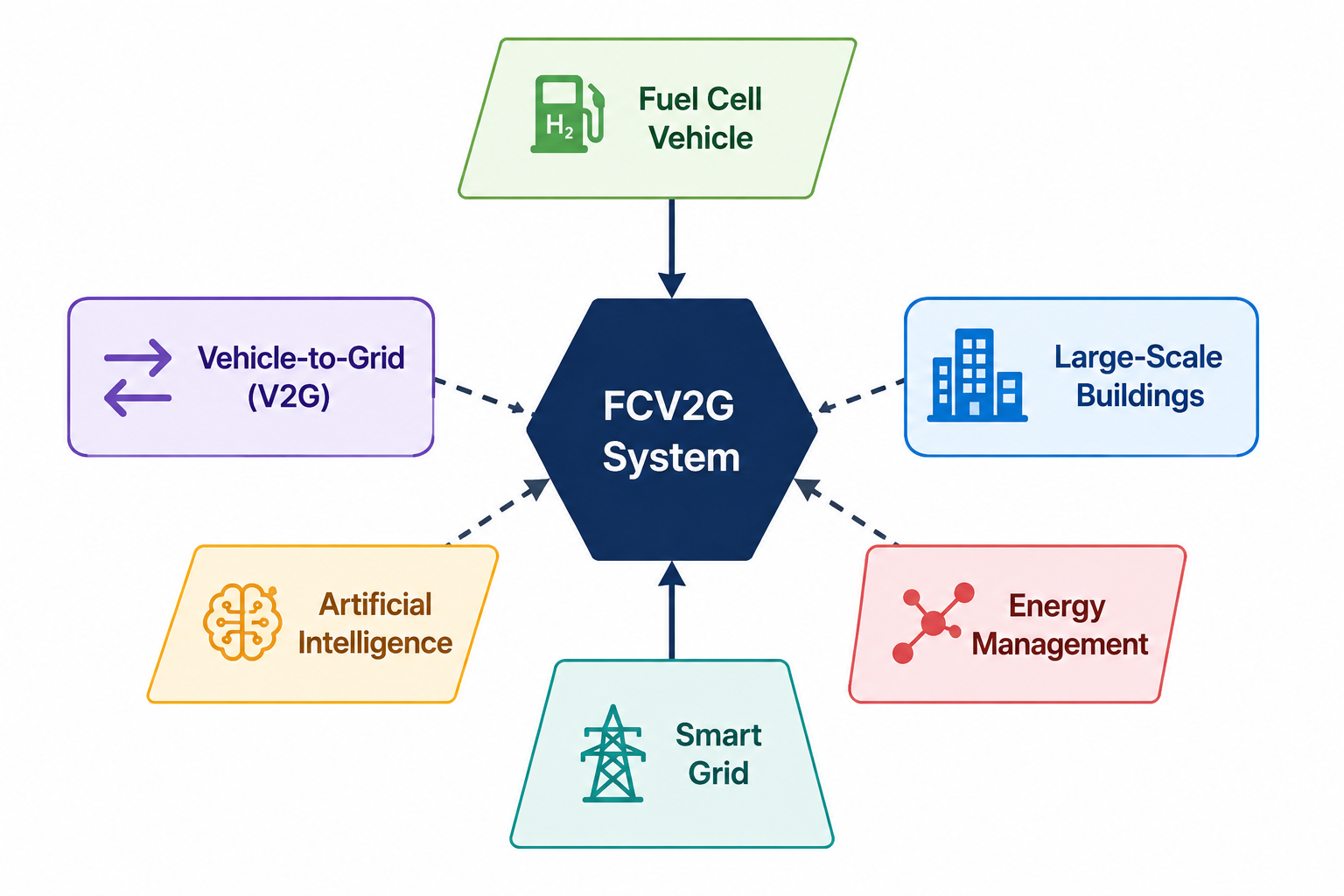
The rapid evolution of smart energy systems has driven the integration of renewable energy technologies, artificial intelligence, and advanced building energy management frameworks. Fuel cell vehicle-to-grid (FCV2G) systems, powered by hydrogen, represent a promising solution for enabling bidirectional energy exchange, improving grid stability, and enhancing energy efficiency in large-scale buildings. However, managing such complex systems requires intelligent, adaptive, and computationally efficient approaches. This paper presents a comprehensive review of artificial intelligence techniques applied to the LightConneuNet architecture for FCV2G-enabled building energy management. LightConneuNet, a lightweight neural network with enhanced connectivity, provides efficient real-time prediction and control capabilities with reduced computational overhead. The review explores its applications in energy forecasting, hydrogen consumption optimization, state-of-health estimation, fault detection, and bidirectional power flow control, supported by optimization techniques such as genetic algorithms, particle swarm optimization, reinforcement learning, and model predictive control. Applications span commercial buildings, campuses, and smart residential systems with integrated renewable energy and hydrogen infrastructure. Empirical findings demonstrate improved efficiency, scalability, and adaptability compared to traditional models. However, challenges including data heterogeneity, infrastructure limitations, and lack of standardized benchmarks persist. This review highlights the potential of combining lightweight deep learning and FCV2G systems to develop intelligent, scalable, and sustainable energy management solutions for future smart buildings.