A Comprehensive Review of Semantic Segmentation and Classification for Ovarian Cancer Detection Using EfficientNetB0 with FPN and Causal Dilated Convolutional Neural Networks
Keywords:
Abstract
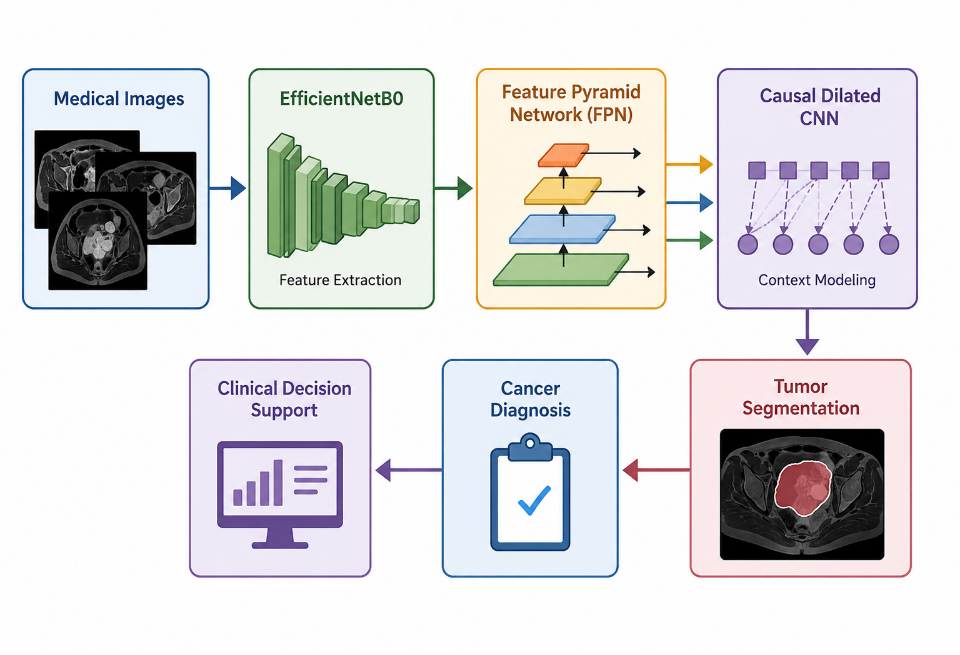
Ovarian cancer is one of the deadliest gynecological malignancies because it is often diagnosed at advanced stages, resulting in poor survival rates. Medical imaging techniques such as ultrasound, magnetic resonance imaging (MRI), and computed tomography (CT) are widely used for tumor detection, but manual interpretation is time-consuming and susceptible to inter-observer variability. Recent advances in deep learning have significantly improved automated ovarian cancer diagnosis through accurate image segmentation and classification. Convolutional Neural Networks (CNNs), particularly EfficientNetB0, provide efficient feature extraction by balancing network depth, width, and resolution while maintaining low computational complexity. When integrated with Feature Pyramid Networks (FPN), EfficientNetB0 effectively captures multi-scale features, enabling precise detection of tumors with varying sizes and shapes. Furthermore, semantic segmentation models accurately delineate tumor boundaries, improving diagnostic consistency and reducing manual effort. Causal dilated convolutional neural networks enhance contextual feature extraction by expanding the receptive field without increasing computational cost, making them suitable for identifying irregular tumor structures. This review examines recent developments in hybrid deep learning architectures that combine EfficientNetB0, FPN, and causal dilated CNNs for ovarian cancer detection. Although these integrated models demonstrate improved segmentation and classification performance, challenges related to limited datasets, model generalization, and clinical validation persist. Future research should emphasize multimodal data fusion, explainable artificial intelligence, and large-scale clinical evaluation to support reliable deployment in healthcare.