A Survey of Methods and Architectures for Convolutional Autoencoder with Dual-Key Transformer Network-Based Causality Analysis of Human Resource Practices on Firm Performance
Keywords:
Abstract
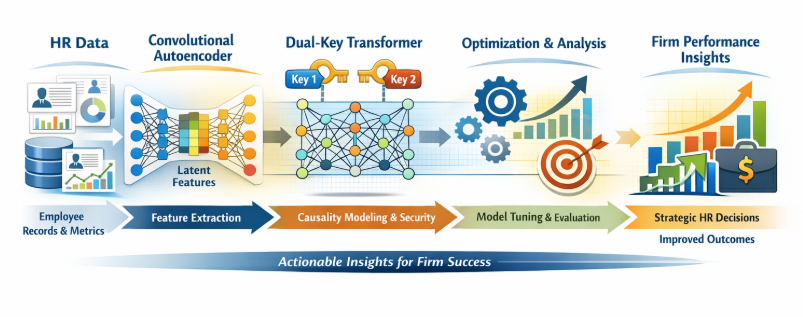
The integration of artificial intelligence in human resource analytics has significantly transformed the evaluation of organizational practices and their impact on firm performance. This paper presents a comprehensive survey of methods and architectures centered on convolutional autoencoders combined with dual-key transformer networks for causality analysis in human resource management. Convolutional autoencoders are widely recognized for their ability to extract meaningful latent representations from high-dimensional HR datasets, while transformer-based architectures provide robust capabilities for modeling sequential dependencies and contextual relationships. The dual-key transformer mechanism further enhances data security and interpretability by incorporating dual attention pathways, ensuring reliable causality inference. This survey systematically examines recent advancements, methodologies, and hybrid frameworks that leverage these techniques to analyze HR practices such as recruitment, training, employee engagement, and retention. The paper also explores optimization strategies, data preprocessing techniques, and evaluation metrics commonly employed in these models. Furthermore, it highlights the challenges associated with data privacy, model complexity, and scalability in real-world applications. By synthesizing current research trends and identifying key gaps, this study provides insights into the future directions of AI-driven HR analytics. The findings emphasize the potential of combining deep learning architectures with causality modeling to enable data-driven decision-making and improve organizational performance outcomes.