A Survey of Methods and Architectures for An Effective Progressive Dense Self-Attention based Human Resource Recommendation for Predicting Employee Turnover
Keywords:
Abstract
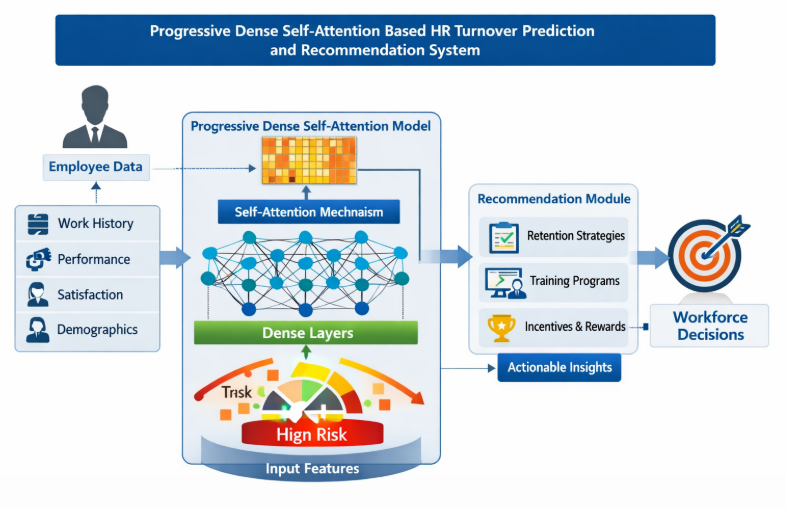
Employee turnover prediction has emerged as a critical research area in human resource analytics due to its direct impact on organizational productivity, financial stability, and talent retention strategies. Traditional statistical approaches often fail to capture complex nonlinear relationships and dynamic dependencies present in employee data. With the advent of deep learning, advanced architectures such as progressive dense networks and self-attention mechanisms have demonstrated superior capability in modeling intricate feature interactions. This paper presents a comprehensive survey of methods and architectures focused on progressive dense self-attention-based frameworks for employee turnover prediction. It systematically reviews existing machine learning, deep learning, and hybrid optimization-based approaches, emphasizing their effectiveness in extracting meaningful insights from structured and unstructured HR datasets. Furthermore, the study explores how recommendation systems integrated with predictive models can assist organizations in making proactive retention decisions. The survey highlights the advantages of progressive feature learning, attention-based contextual understanding, and optimization strategies in improving prediction accuracy. Challenges such as data imbalance, interpretability, and real-world deployment are also discussed. This work aims to provide a consolidated understanding of current advancements while identifying future research directions for developing intelligent, scalable, and interpretable HR analytics systems.