Deep Learning and Optimization Approaches in IoT based Human Resources Balanced Allocation Method Based on Recalling-Enhanced Salp Swarm Recurrent Neural Network: A Review
Keywords:
Abstract
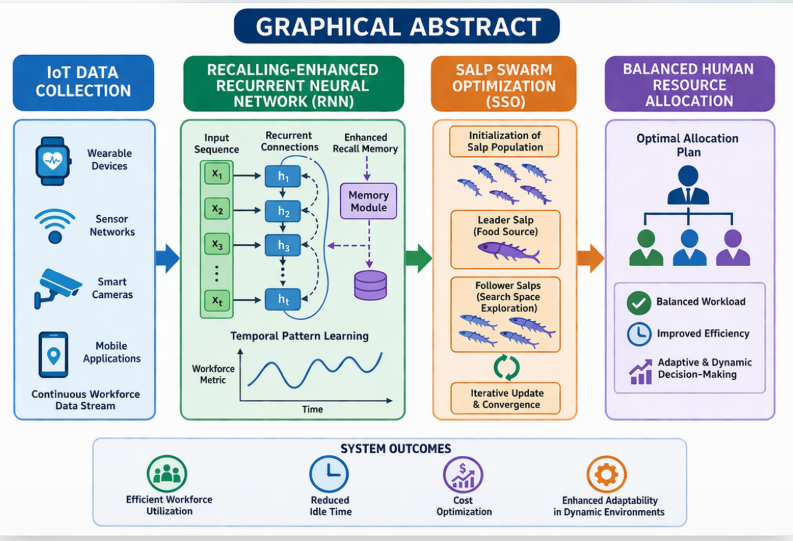
The rapid evolution of Internet of Things (IoT) technologies has significantly transformed organizational environments by enabling real-time data acquisition and intelligent decision-making. In the context of human resource management, balancing workforce allocation remains a critical challenge due to dynamic workloads, varying employee capabilities, and temporal dependencies. This paper presents a comprehensive review of deep learning and optimization approaches for IoT-based human resource balanced allocation, with a particular focus on recalling-enhanced salp swarm recurrent neural networks. The integration of IoT sensors facilitates continuous monitoring of employee activities and environmental conditions, generating high-dimensional temporal data. Recurrent neural networks, enhanced with recalling mechanisms, effectively capture long-term dependencies in such sequential data, improving predictive accuracy in workforce demand estimation. Additionally, the salp swarm algorithm serves as a powerful optimization technique inspired by swarm intelligence, enabling efficient exploration and exploitation of solution spaces for optimal resource allocation. The synergy between deep learning and metaheuristic optimization provides a robust framework for adaptive and scalable human resource management. This review analyzes existing methodologies, highlights their strengths and limitations, and identifies research gaps in hybrid architectures combining IoT, deep learning, and optimization techniques. The findings suggest that recalling-enhanced models significantly improve allocation efficiency, reduce operational costs, and enhance organizational productivity. Future research directions emphasize explainability, real-time deployment, and integration with edge computing for improved responsiveness in smart organizational ecosystems.