Ambient Intelligence and Digital Phenotyping: A Multi-Layered Framework for Context-Aware Alzheimer’s Care and Cognitive Support
Keywords:
Abstract
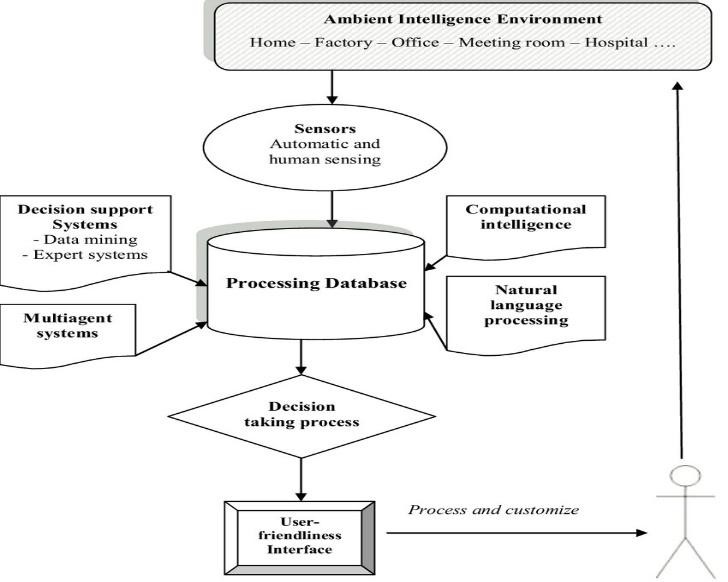
The management of ADRD patients is moving more and more toward a continuous monitoring approach using everyday environments rather than the traditional episodic clinical testing. Although classical neuropsychological evaluation is still helpful, it fails to recognize the minor changes in behavior that mark the early phase of cognitive decline. Ambient intelligence, in conjunction with digital phenotyping, may offer an alternative approach for unobtrusive continuous monitoring of ADRD patients. In this paper, we present a hierarchical architecture that may be applied to monitor and aid ADRD patients. The proposed hierarchical architecture is composed of wearable devices, motion sensor analysis, acoustic signal processing, machine learning algorithms, and context-aware natural language processing. Besides detecting behavior modifications that might signify the onset of the illness, the proposed architecture also enables real-time assistance to the patients. Moreover, the proposed architecture addresses the requirement for privacy-preserving solutions, such as federated learning, and the ethical concerns that must be taken into account during the process. Additionally, the proposed architecture considers the legal requirements that should be met in such a system and the critical human-centered design factors.