FinTrust-Chain: An AI-Augmented Blockchain-Enabled Trust Architecture for Fraud Risk Assessment and Integrity Assurance in Digital Payment Systems
Keywords:
Abstract
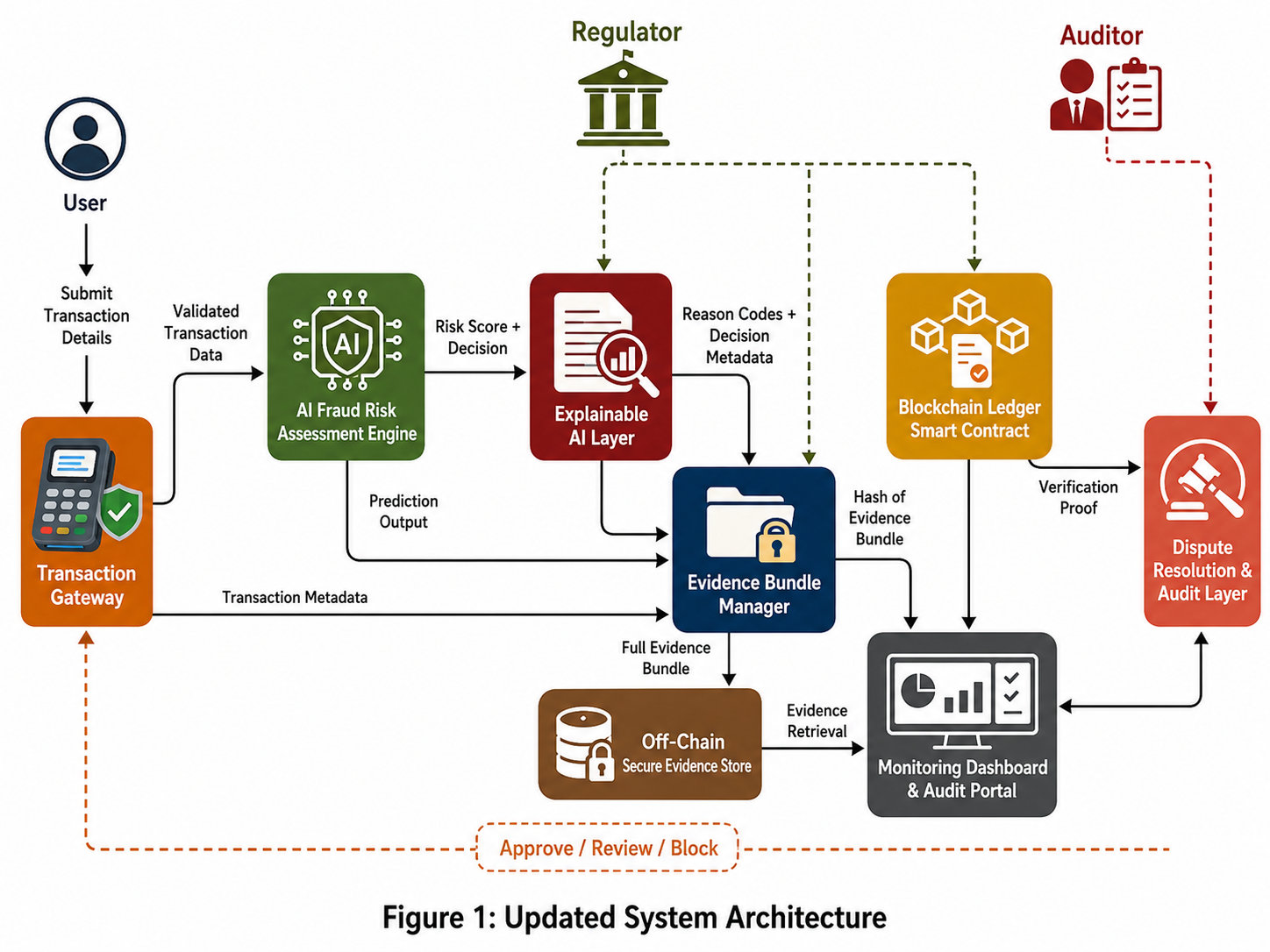
The rapid expansion of digital payment systems has improved transaction speed and accessibility, but it has also increased the risk of financial fraud, unauthorized activity, and trust-related failures. Conventional rule-based fraud detection methods are limited in handling dynamic attack patterns, while many machine learning-based approaches lack explainability, auditability, and verifiable evidence management. To address these limitations, this paper presents FinTrust-Chain, an AI-augmented blockchain-enabled trust architecture for fraud risk assessment and integrity assurance in digital payment systems. The proposed system evaluates each transaction through an intelligent risk scoring model designed to identify suspicious and rare fraudulent activities in highly imbalanced transaction data. An explainability layer is integrated to generate human-understandable reason codes for each prediction, improving decision transparency for users, investigators, and auditors. To strengthen evidence integrity, critical transaction records, model outputs, and explanation vectors are stored off-chain, while their cryptographic hashes are anchored on a blockchain to provide tamper-resistant and verifiable audit trails. The framework also includes a structured dispute resolution mechanism that tracks fraud-related cases from initiation to final decision. The system is designed for real-time operation, with an approximate end-to-end processing latency of 0.25 seconds per transaction. By combining high-recall fraud risk assessment, explainable.