Contextual Natural Language Processing Models for Domain-Specific Information Retrieval
Keywords:
Abstract
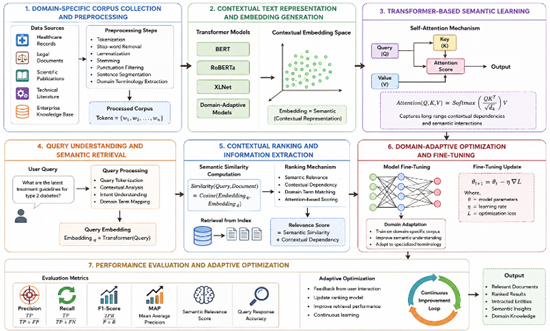
The rapid advancement of Artificial Intelligence (AI), Natural Language Processing (NLP), deep learning, and large-scale textual analytics has significantly transformed modern information retrieval systems and intelligent knowledge management applications. Information retrieval plays a critical role in numerous domains including healthcare, legal systems, scientific research, cybersecurity, finance, education, enterprise analytics, and digital libraries where users require accurate retrieval of highly relevant domain-specific textual information from massive unstructured data repositories. Traditional keyword-based retrieval techniques such as TF-IDF and Boolean search frequently struggle to capture semantic relationships, contextual meaning, latent linguistic dependencies, and domain-specific terminology within complex textual environments. These limitations reduce retrieval precision and negatively affect knowledge discovery capability in specialized domains containing heterogeneous textual structures and contextual semantics. Recent advancements in contextual Natural Language Processing models, Transformer architectures, attention mechanisms, and deep semantic representation learning have significantly improved domain-specific information retrieval performance. Contextual NLP frameworks such as BERT, RoBERTa, GPT, XLNet, and domain-adaptive Transformer models effectively capture semantic relationships, contextual dependencies, syntactic structure, and latent linguistic representation within textual data. These models enable intelligent retrieval systems to understand contextual meaning and semantic relevance rather than relying solely on lexical keyword matching. Furthermore, contextual embedding techniques and domain adaptation mechanisms significantly improve retrieval precision, semantic ranking, and knowledge extraction capability across heterogeneous domain-specific corpora.