Deep Learning-Based Intrusion Detection Systems for Software-Defined Networking
Keywords:
Abstract
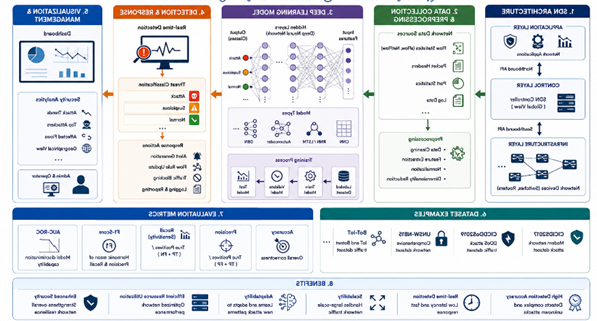
Software-Defined Networking (SDN) has emerged as a transformative networking paradigm that separates the control plane from the data plane, enabling centralized network management, programmability, flexibility, and efficient traffic control in modern communication infrastructures. SDN plays a significant role in cloud computing, Internet of Things (IoT), 5G communication systems, and enterprise network environments. However, the centralized control architecture of SDN introduces severe security vulnerabilities, making SDN environments highly susceptible to cyber threats such as Distributed Denial-of-Service (DDoS) attacks, malware propagation, spoofing attacks, botnet activities, and unauthorized access. Traditional intrusion detection systems often fail to provide efficient real-time detection of sophisticated and evolving cyber threats in dynamic SDN infrastructures due to limitations related to scalability, adaptability, and high false-positive rates. To address these challenges, this research proposes a Deep Learning-Based Intrusion Detection System for Software-Defined Networking that integrates deep neural networks, intelligent traffic analysis, anomaly detection, and adaptive security mechanisms into a unified SDN security framework. The proposed architecture utilizes deep learning models such as Convolutional Neural Networks (CNN), Recurrent Neural Networks (RNN), and Long Short-Term Memory (LSTM) networks to analyze SDN traffic patterns and detect malicious activities with high accuracy. The framework incorporates centralized SDN controllers, intelligent flow monitoring, feature extraction modules, and automated mitigation mechanisms to enhance network visibility and threat response efficiency. Furthermore, the proposed model integrates adaptive learning strategies and real-time traffic analytics to improve attack classification and reduce false-positive rates in large-scale SDN environments. Experimental evaluation demonstrates that the proposed framework significantly improves intrusion detection accuracy, threat prediction capability, response efficiency, and network scalability compared with traditional machine learning and rule-based intrusion detection systems. The proposed architecture establishes a robust and intelligent cybersecurity framework suitable for securing next-generation SDN infrastructures against advanced cyber threats.