Graph Neural Network-Based Scene Understanding for Real-Time Autonomous Navigation
Keywords:
Abstract
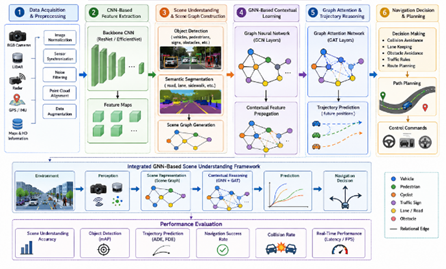
Real-time scene understanding is one of the most critical components of autonomous navigation systems because intelligent vehicles and robotic platforms must continuously perceive, interpret, and respond to dynamic environments with high accuracy and low latency. Traditional computer vision and deep learning approaches such as Convolutional Neural Networks (CNNs) have achieved significant success in object detection, semantic segmentation, and environmental perception tasks. However, conventional CNN-based methods often struggle to capture complex relational dependencies and contextual interactions between objects within dynamic driving scenes. Autonomous environments contain highly interconnected entities such as vehicles, pedestrians, traffic signs, lanes, and obstacles, where understanding spatial and semantic relationships is essential for safe navigation and intelligent decision-making. Graph Neural Networks (GNNs) have recently emerged as powerful architectures for modeling structured relational information through graph-based representation learning. By representing scene components as graph nodes and their contextual interactions as edges, GNNs can effectively capture spatial dependencies, semantic correlations, and dynamic environmental relationships within autonomous navigation systems. This research proposes a Graph Neural Network-based scene understanding framework for real-time autonomous navigation that integrates object detection, scene graph construction, graph attention learning, and intelligent navigation decision mechanisms. The proposed framework combines CNN-based visual feature extraction with graph-based contextual reasoning to improve environmental perception, obstacle understanding, trajectory prediction, and navigation robustness in dynamic traffic environments. The methodology utilizes scene graph generation to represent road entities and contextual interactions, followed by Graph Convolutional Networks (GCNs) and Graph Attention Networks (GATs) for relational feature propagation and contextual scene reasoning. The proposed framework is evaluated using benchmark autonomous driving datasets including KITTI, Cityscapes, and nuScenes. Experimental results demonstrate that the proposed GNN-based framework significantly improves scene understanding accuracy, object interaction reasoning, trajectory prediction reliability, and navigation safety compared with traditional CNN-based autonomous perception systems.