Quantum Machine Learning Approaches for Complex Optimization in Smart Computing Systems
Keywords:
Abstract
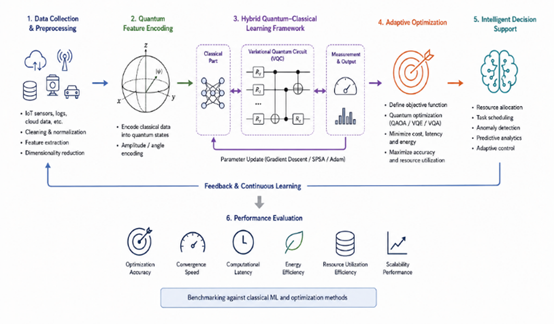
Quantum Machine Learning (QML) has emerged as a transformative paradigm that integrates the computational advantages of quantum computing with the adaptive intelligence of machine learning to solve complex optimization problems in smart computing systems. Traditional optimization techniques often struggle with high-dimensional search spaces, combinatorial complexity, computational overhead, and scalability limitations in applications such as intelligent transportation, healthcare analytics, smart manufacturing, cybersecurity, cloud computing, and Internet of Things (IoT) infrastructures. QML approaches exploit quantum superposition, entanglement, and quantum parallelism to accelerate optimization tasks and enhance predictive performance beyond classical machine learning capabilities. This research proposes a hybrid Quantum Machine Learning optimization framework that combines Variational Quantum Circuits (VQCs), Quantum Neural Networks (QNNs), and classical deep learning models to address resource allocation, task scheduling, energy optimization, and intelligent decision-making in smart computing environments.
The proposed framework integrates quantum-enhanced feature extraction, adaptive optimization layers, and reinforcement-based learning mechanisms to improve convergence speed and computational efficiency. Experimental analysis is performed using benchmark optimization datasets and simulated quantum environments to evaluate accuracy, execution time, energy efficiency, and scalability. Comparative results demonstrate that the proposed QML-based framework achieves superior optimization accuracy, reduced computational latency, and improved resource utilization when compared with traditional machine learning and classical metaheuristic optimization methods. Furthermore, the study highlights the practical significance of hybrid quantum-classical architectures in next-generation intelligent systems where large-scale optimization and real-time decision support are critical. The findings suggest that QML can significantly contribute to the advancement of sustainable, adaptive, and high-performance smart computing ecosystems while opening new directions for future quantum-aware intelligent infrastructures.