A Comprehensive Review of Early Detection and segmentation of Diabetic Foot Ulcer Risk Zones Using a Cycle-Consistent Adversarial Adaptation Network from multimodal images
DOI:
https://doi.org/10.65521/mjret.v12i2.2794Keywords:
Abstract
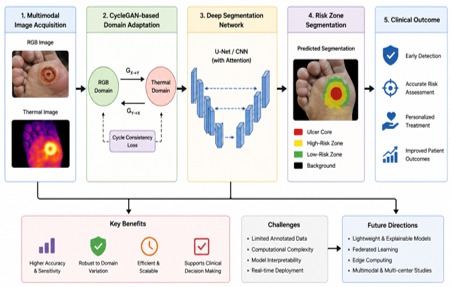
Diabetic Foot Ulcers (DFUs) are among the most serious complications of diabetes and can lead to infection, amputation, and increased mortality if not identified early. Accurate detection and segmentation of DFU risk zones are essential for timely diagnosis and effective treatment planning. Traditional image-based assessment methods often face limitations due to variations in lighting, tissue appearance, and limited annotated medical datasets. Recent advancements in deep learning and adversarial learning have introduced more reliable approaches for DFU analysis using multimodal medical imaging. This review focuses on Cycle-Consistent Adversarial Adaptation Networks (CycleGAN) for early DFU detection and segmentation using RGB and thermal images. Multimodal imaging provides complementary information related to tissue texture, temperature distribution, and inflammation patterns, improving diagnostic accuracy. CycleGAN-based frameworks enable unsupervised domain adaptation between imaging modalities, allowing effective feature learning even without paired datasets. Deep learning architectures such as U-Net and convolutional neural networks further enhance ulcer boundary segmentation and risk zone classification. These approaches improve Dice coefficient, sensitivity, accuracy, and robustness against domain variations compared to conventional methods. Despite these advancements, challenges including data scarcity, computational complexity, and model interpretability remain significant concerns in real-time clinical deployment.