Power Factor Improvement Techniques for Industrial Electrical Loads
DOI:
https://doi.org/10.65521/itsi-teee.v4i1.4262Keywords:
Abstract
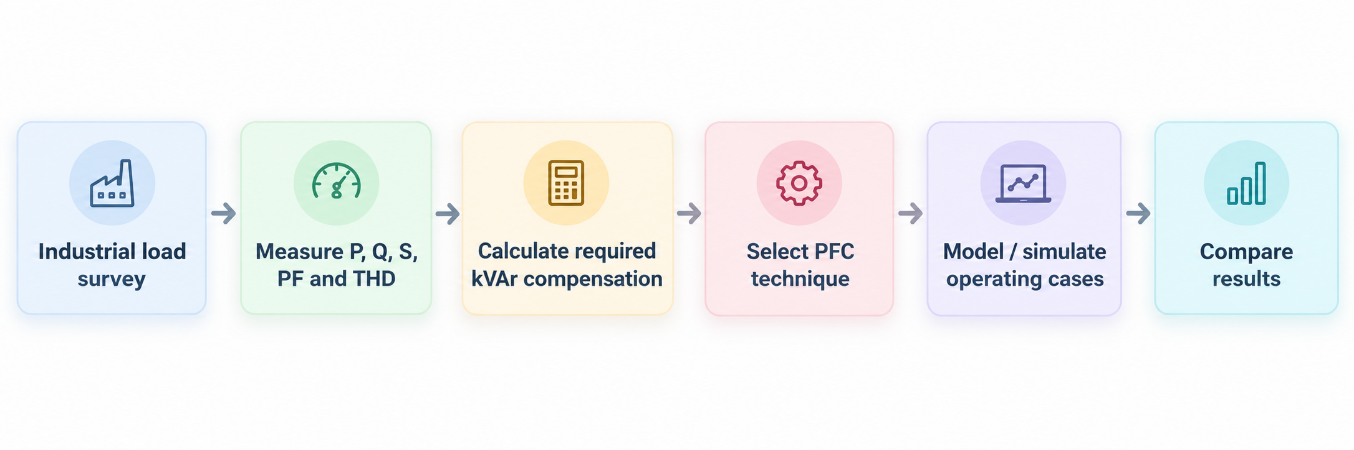
Industrial facilities commonly operate induction motors, transformers, rectifiers, welding equipment, variable-speed drives, arc furnaces, and other loads that draw substantial reactive and harmonic current. A low power factor increases apparent power, feeder current, copper loss, voltage drop, and utility demand charges even when useful active power remains unchanged. This methodology paper develops a structured procedure for selecting and evaluating power-factor improvement techniques for representative three-phase industrial loads. The approach combines load survey, active-reactive power measurement, compensation sizing, harmonic assessment, and comparative modeling of conventional capacitor banks, shunt active power filters, and hybrid passive-active compensation. For a representative 400 V, 100 kW load operating initially at 0.72 power factor, the calculated reactive compensation required to raise the displacement power factor to 0.95 is approximately 63.5 kVAr. Analytical and simulation-based comparison shows that capacitor compensation offers the simplest reduction in reactive demand and feeder current, whereas active and hybrid filters are better suited to installations where nonlinear loads and harmonics prevent conventional capacitors from delivering satisfactory true power factor. The proposed method therefore emphasizes both reactive-power correction and harmonic compatibility rather than treating power factor as a single steady-state quantity. The framework is suitable for industrial audits, retrofit studies, and preliminary design of automatic compensation systems using literature available through 2015.