Implementation of Wireless Sensor Networks for Industrial Monitoring Applications
DOI:
https://doi.org/10.65521/itsi-teee.v6i1.4246Keywords:
Abstract
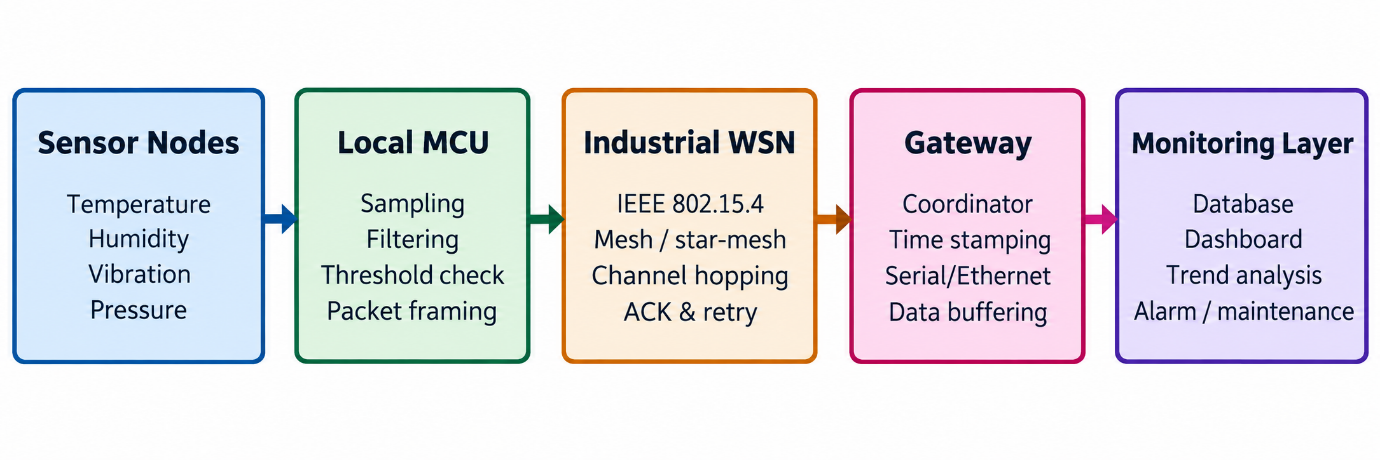
Wireless sensor networks (WSNs) provide a practical alternative to extensive cabling for monitoring industrial assets, process variables, and environmental conditions. Their adoption, however, is constrained by radio interference, metallic obstructions, limited energy, deterministic reporting requirements, and the need for secure and reliable data delivery. This paper presents a methodology for implementing a low-cost industrial WSN that acquires temperature, humidity, vibration, and pressure data and forwards them to a monitoring station for visualization and alarm generation. The proposed architecture uses distributed sensor nodes, a low-power IEEE 802.15.4-class radio interface, multi-hop communication where required, and a gateway connected to a supervisory computer. The methodology covers node selection, sensor interfacing, packet formation, network association, channel selection, threshold-based event detection, data logging, and performance evaluation. Reliability is assessed using packet delivery ratio, end-to-end latency, link quality, sensing error, and alarm-detection performance. An illustrative prototype evaluation indicates that a carefully planned deployment can maintain high packet delivery under normal industrial interference while preserving sub-second alarm reporting. The approach emphasizes modularity, low deployment cost, and compatibility with industrial wireless design principles established before 2018. The methodology can therefore be adapted to equipment-condition monitoring, utility supervision, safety sensing, and predictive-maintenance data acquisition in small and medium industrial facilities.