Automatic Fault Detection and Protection Scheme for Electrical Distribution Networks
DOI:
https://doi.org/10.65521/itsi-teee.v6i1.4238Keywords:
Abstract
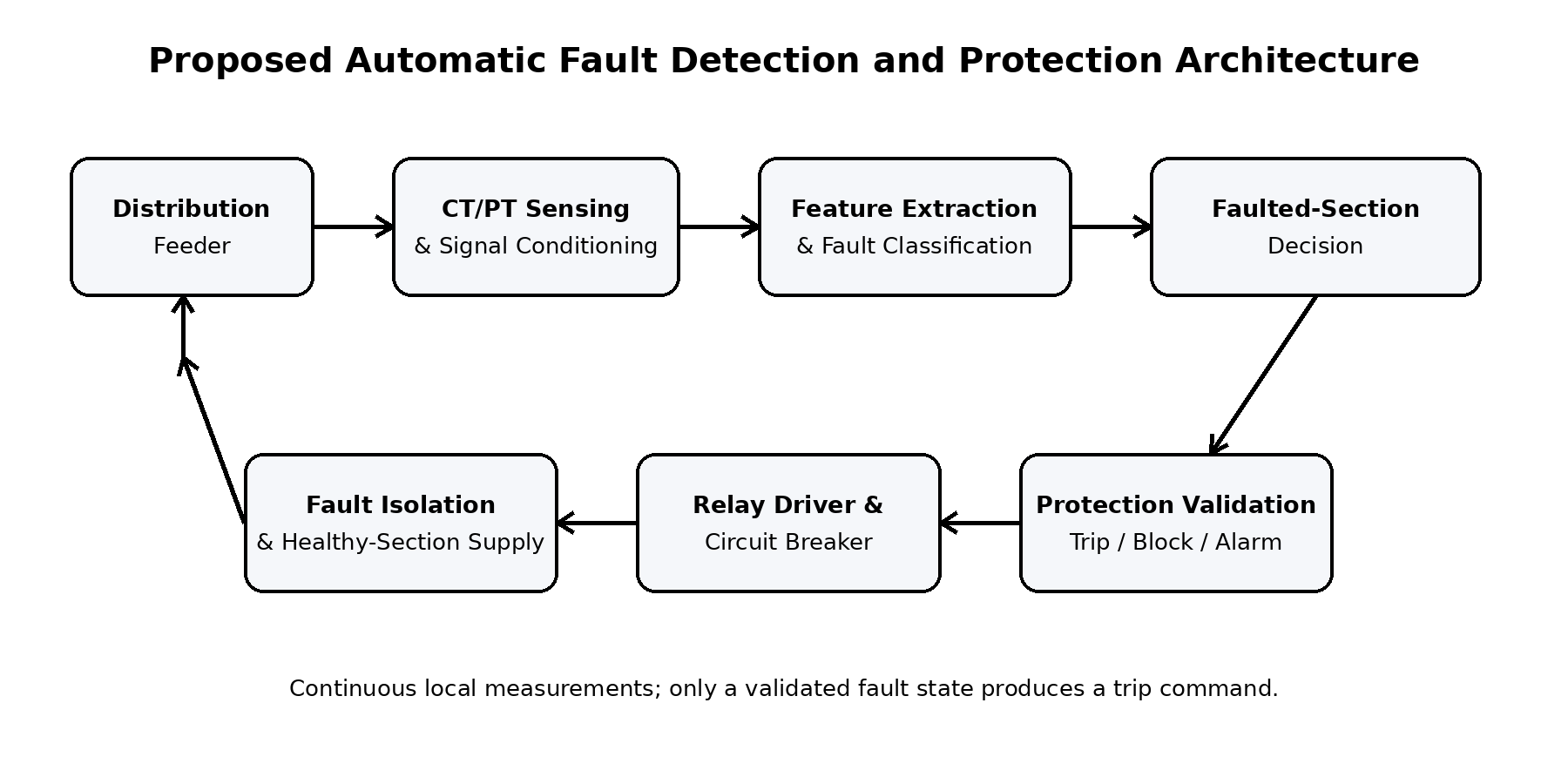
Electrical distribution networks are exposed to short-circuit, earth, conductor, equipment, and high-impedance faults that can interrupt supply and damage apparatus if the abnormal condition is not detected and isolated quickly. This paper presents a methodology for an automatic fault detection and protection scheme intended for radial and moderately active distribution feeders. The proposed scheme combines continuous voltage and current acquisition with threshold-based supervision, symmetrical-component indicators, discrete-wavelet transient features, and feeder-section decision logic. A digital controller or intelligent electronic device receives conditioned CT/PT signals, calculates root-mean-square and sequence quantities, verifies the persistence of an abnormal event, classifies the fault, estimates the affected section, and issues a trip command to the associated circuit breaker. The protection logic also includes blocking criteria to prevent operation during permissible load switching and short-duration disturbances. A simulation-oriented test procedure is defined using an 11-kV feeder subjected to single-line-to-ground, line-to-line, double-line-to-ground, three-phase, high-resistance, and non-fault switching cases. Representative simulation results show detection within approximately one power-frequency cycle for low-resistance faults, correct discrimination of the studied fault types, and fault-section estimation errors below 4% in the tested cases. The method emphasizes low computational complexity, selective isolation, and compatibility with feeder automation. The proposed framework therefore provides a practical basis for implementing automatic fault detection, isolation, and protection in conventional or progressively automated distribution networks.