Development of an Intelligent Energy Management System for Smart Grid Applications
DOI:
https://doi.org/10.65521/itsi-teee.v10i1.4225Keywords:
Abstract
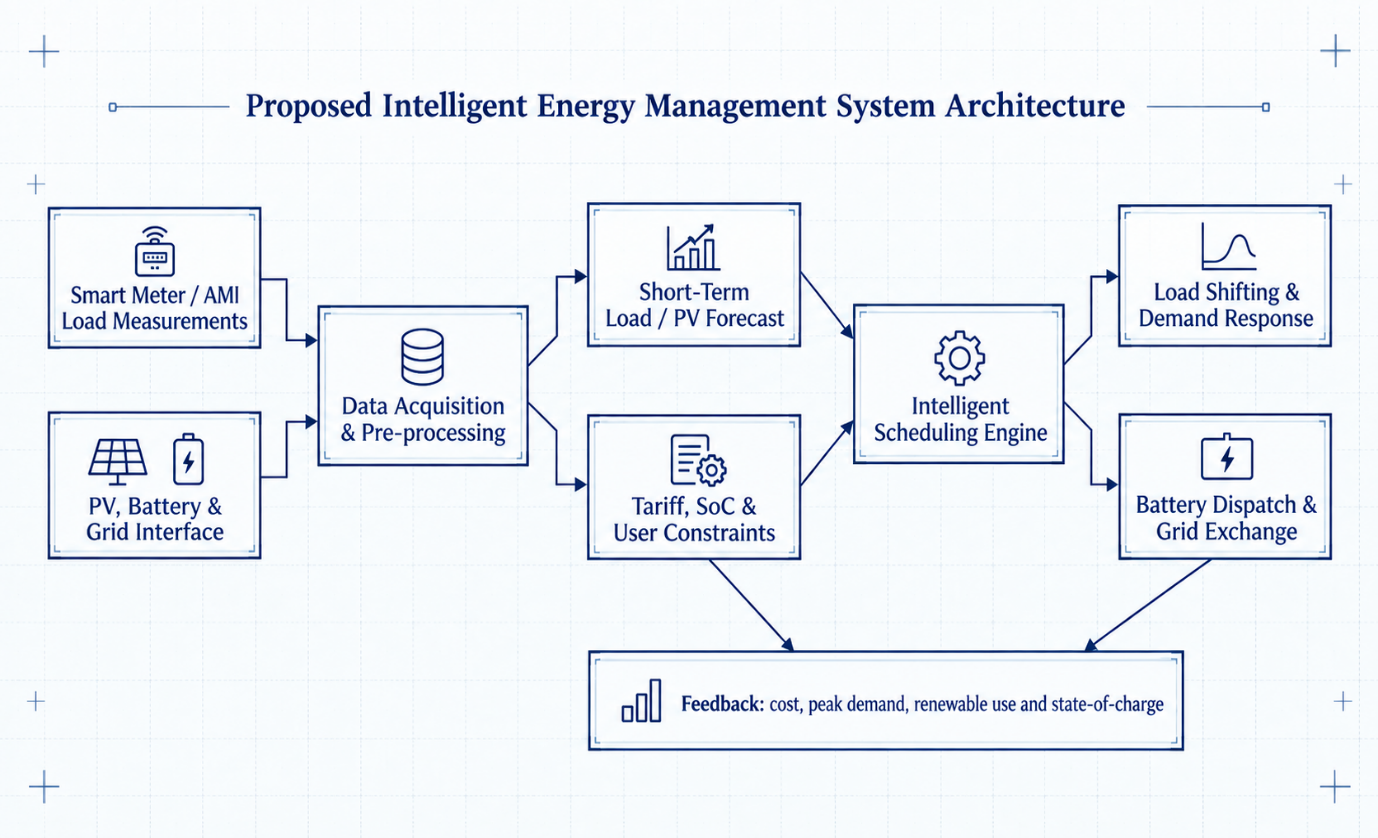
The increasing penetration of renewable generation, distributed storage, smart meters, controllable loads, and dynamic electricity tariffs has created a need for energy management systems that can make coordinated decisions in real time. This paper presents a methodology for developing an Intelligent Energy Management System (IEMS) for smart grid applications. The proposed architecture combines advanced metering infrastructure, short-term demand and photovoltaic generation information, battery state-of-charge monitoring, user-defined operating constraints, and an intelligent scheduling layer. The control objective is formulated as a multi-objective problem that minimizes electricity cost, peak grid demand, and unnecessary grid import while preserving the required energy service. A simulation-based case study is used to evaluate the method under time-of-use pricing with a photovoltaic source, an 8 kWh battery, and flexible residential loads. Relative to unmanaged operation, the proposed scheduling strategy reduces the daily energy-cost index from 6.61 to 5.06 units, lowers peak grid demand from 4.20 kW to 2.40 kW, and decreases daily grid import from 28.20 kWh to 23.70 kWh. Photovoltaic self-consumption improves from 59.1% to 80.1%. These results indicate that coordinated load shifting and storage dispatch can provide economically and technically useful demand-side flexibility. The methodology is intended as a reproducible framework for subsequent hardware-in-the-loop or field implementation in smart homes, buildings, microgrids, and distribution-level smart grid platforms.