Power Quality Enhancement in Distribution Systems Using DSTATCOM
DOI:
https://doi.org/10.65521/itsi-teee.v8i1.4221Keywords:
Abstract
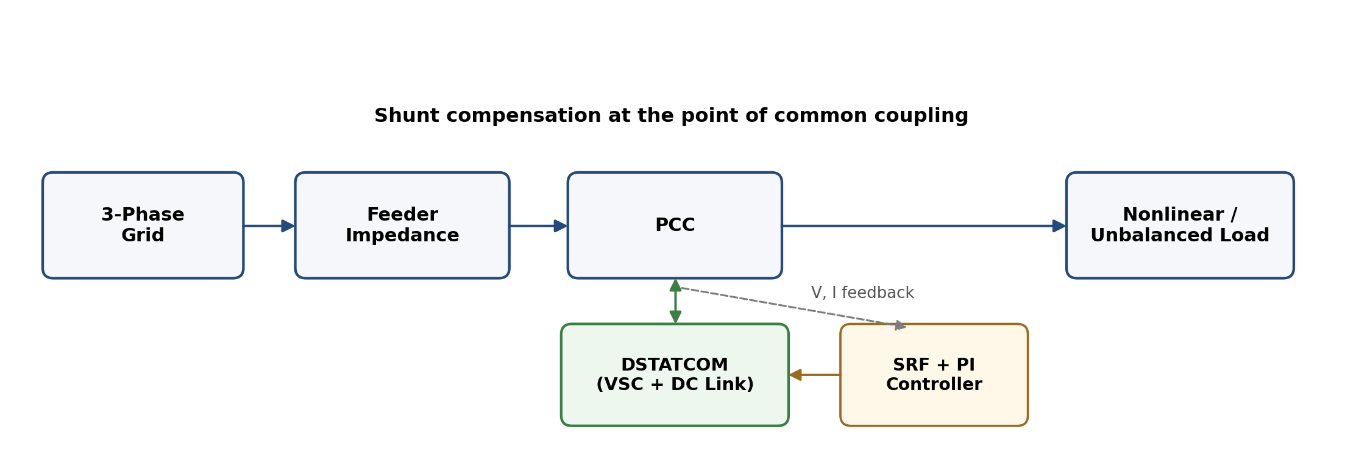
Modern distribution systems increasingly supply nonlinear, unbalanced and electronically controlled loads that draw distorted and reactive current, causing poor power factor, excessive current total harmonic distortion (THD), voltage deviation and additional feeder losses. This methodology paper develops a compact DSTATCOM-based power-quality enhancement framework for a three-phase distribution feeder. The proposed system employs a voltage-source converter connected in shunt at the point of common coupling, a dc-link capacitor, interfacing inductors and a synchronous-reference-frame (SRF) controller. The controller extracts the fundamental active and reactive components of load current, regulates dc-link voltage through a proportional-integral loop and generates reference compensating currents for hysteresis/PWM switching. A MATLAB/Simulink-oriented test methodology is defined for balanced, unbalanced and nonlinear load conditions and for a temporary voltage sag. Representative simulation results show that source-current THD can be reduced from 18.4% to 3.2%, source power factor can improve from 0.78 to 0.99, and the PCC voltage during the sag can recover from 0.82 pu to approximately 0.98 pu. The study demonstrates that a properly controlled DSTATCOM can combine harmonic filtering, reactive-power compensation, load balancing and voltage support in a single shunt device while maintaining a practical control structure suitable for distribution-level implementation.